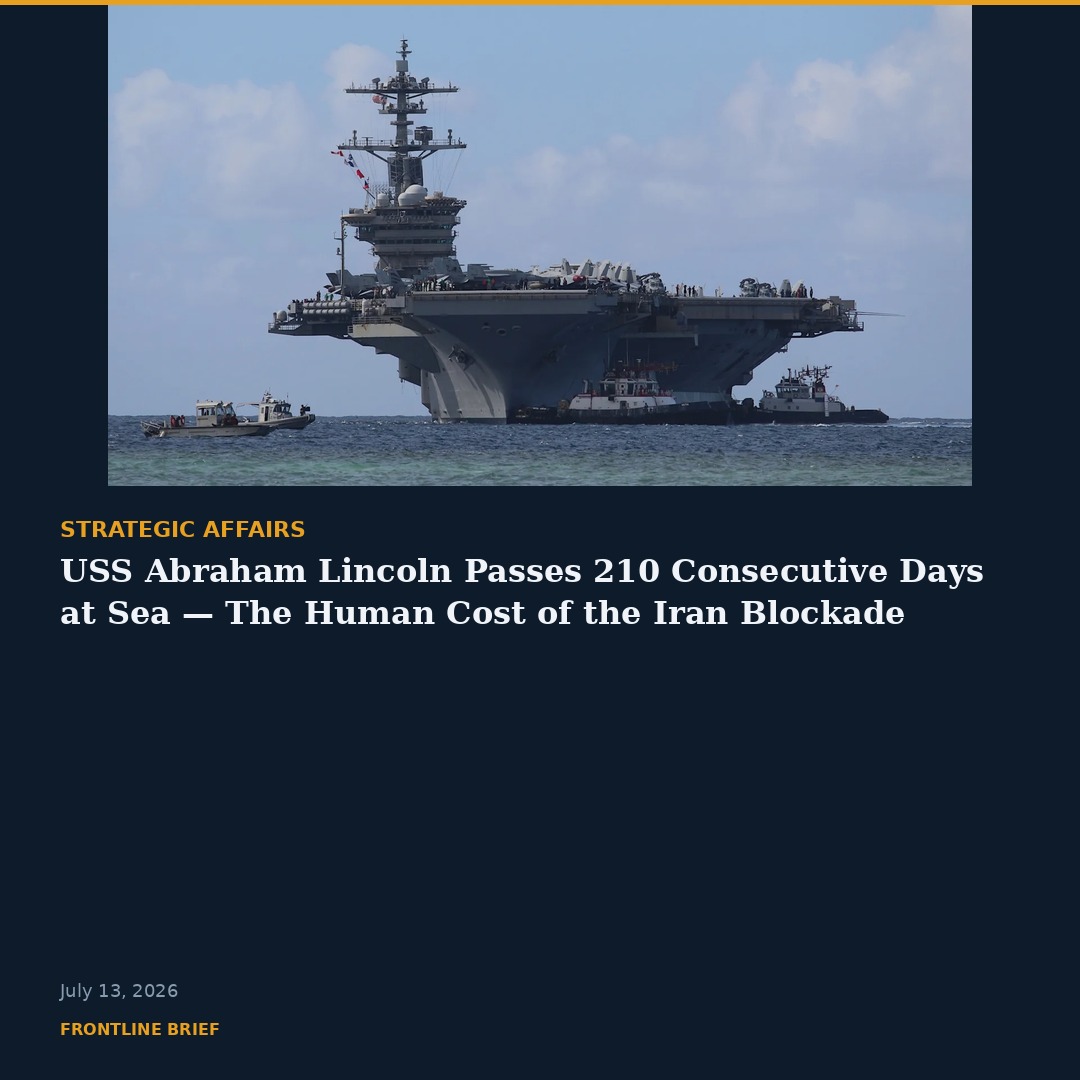
The Nimitz-class aircraft carrier USS Abraham Lincoln (CVN-72) has been continuously at sea for more than 210 days — over seven months without a single port call — in what appears to be a record-setting deployment for the modern US Navy. Lincoln, the flagship of Carrier Strike Group 3, departed Naval Base Guam on 12 December 2025 and has not touched land since, sustaining continuous combat and blockade operations through Operation Epic Fury and the subsequent Iran naval blockade.
The Deployment
Lincoln deployed with Carrier Air Wing 9 (CVW-9) to the US 5th Fleet area of operations in the Middle East, arriving in theatre in time for the opening of Operation Epic Fury on 28 February 2026. The strike group participated in the air campaign against Iran, with CVW-9's F/A-18E/F Super Hornets and EA-18G Growlers flying combat sorties against Iranian air defences, IRGC facilities and nuclear-related infrastructure. When the air campaign transitioned into the ongoing blockade and deterrence posture, Lincoln remained on station — cycling through sustained operations without the crew relief, maintenance availability and morale breaks that port calls provide.
The self-described "most capable CSG in the fleet" has been resupplied at sea throughout the deployment via underway replenishment, with ammunition, fuel, food and stores transferred from Combat Logistics Force ships while both vessels steam alongside at speed. But underway replenishment is not a port call. The crew has not set foot on land in over seven months.
The Human Cost
Extended deployments at sea impose cumulative costs on personnel that no amount of operational tempo can compensate for. Sleep deprivation, separation from families, limited recreational facilities and the psychological weight of sustained combat operations erode readiness in ways that are difficult to measure but impossible to ignore. The US Navy's own retention data has consistently shown that deployment length is the single strongest predictor of whether sailors choose to leave the service — ahead of pay, advancement opportunity and working conditions.
Lincoln's 210-day continuous deployment is occurring against a backdrop of chronic manning shortfalls across the fleet. The Navy is already short thousands of sailors in critical ratings, and the Iran war has forced multiple carrier strike groups into extended rotations that compress maintenance periods and reduce training time between deployments. The operational imperative is clear — the blockade must be sustained — but the long-term cost to fleet readiness and retention is accumulating.
Historical Context
The longest known continuous deployment in US Navy carrier history was USS Theodore Roosevelt's 206-day combat deployment during Operation Enduring Freedom in 2001–2002. Lincoln's current deployment has surpassed that mark and continues. During the Vietnam War, carriers routinely conducted Yankee Station line periods of 30–45 days between port calls; 210 consecutive days without land would have been considered unsustainable even by that era's standards.
Strategic Implications
Lincoln's marathon deployment illustrates a structural problem that extends beyond the Iran crisis. The US Navy operates eleven carrier strike groups to maintain continuous global presence across the Indo-Pacific, the Middle East and the Atlantic. The standard deployment cycle — train, deploy, maintain — requires roughly three carriers for every one on station. When crises extend deployments and compress maintenance, the ratio breaks. The Iran war has already forced the Navy to extend multiple deployments beyond the seven-month standard, delay planned maintenance availabilities and accelerate carrier preparations.
For America's strategic competitors, the message is double-edged. On one hand, 210 days at sea demonstrates a level of sustained naval capability that no other country can match. On the other, it reveals the fragility of a fleet that can be stretched to breaking point by a single regional conflict — raising questions about what would happen if a second crisis erupted simultaneously in the Western Pacific.