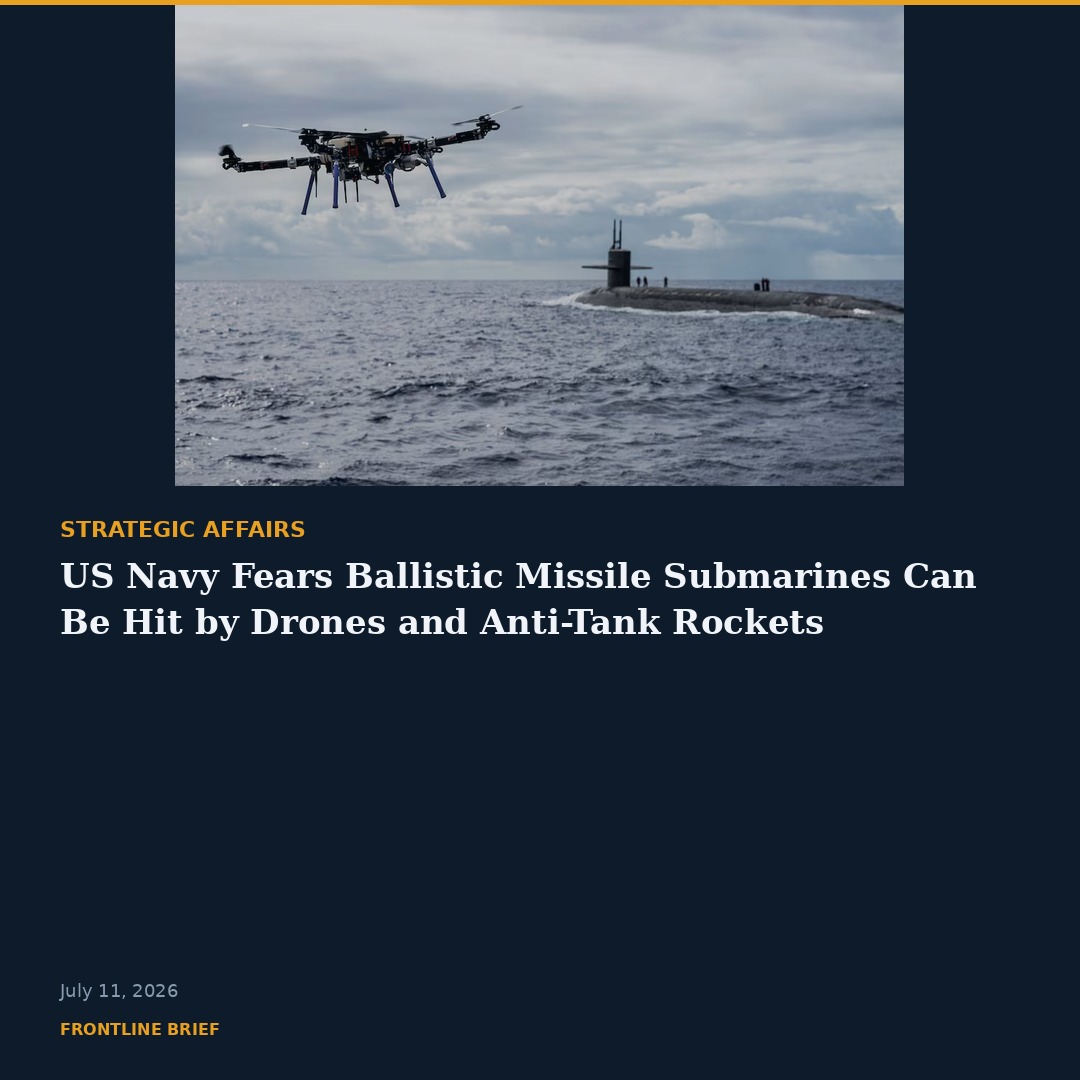
The United States Navy has issued a formal Sources Sought notice through its Strategic Systems Program, requesting prototype technologies across 22 focus areas to protect its fleet of nuclear-armed ballistic missile submarines — SSBNs — from a new generation of threats that include drones, anti-tank guided missiles, unmanned underwater vehicles, AI-enabled swarms and cyberattacks. The announcement, published on the SAM.gov procurement platform, signals that the service now regards the vulnerability of its most survivable nuclear deterrent platform as a problem requiring urgent industrial and technological attention.
The Vulnerability Window
When submerged and patrolling the deep ocean, an Ohio-class or future Columbia-class SSBN is effectively invulnerable — hidden by thousands of metres of seawater from any conventional detection method. But that invulnerability evaporates the moment the submarine surfaces, enters port or transits through restricted waterways to and from its dive point. In these windows, an SSBN is a slow, unarmed, thin-hulled vessel with no self-defence capability against the asymmetric threats that have proliferated since the onset of the drone age.
Ukraine demonstrated the reality of this threat in December 2025, when it claimed to have damaged the Russian submarine Novorossiysk in port using an unmanned underwater drone. Guerrilla or terrorist groups operating along a waterway could engage a transiting submarine with shoulder-launched anti-tank rockets or wire-guided ATGMs — weapons widely available on the global black market and requiring minimal training to employ.
What the Navy Wants
The Sources Sought notice identifies requirements across the full spectrum of the SSBN's operational cycle. For shore installations and port security, the Navy is seeking detection, tracking, identification and defeat capabilities against unmanned systems across all domains — air, surface, subsurface and ground. These include unmanned surface vehicles for waterside patrol, unmanned ground vehicles for perimeter screening, and robotic inspection platforms that integrate with existing response forces.
For the transit phase — the period between leaving the pier and reaching the dive point where the submarine submerges — the Navy requires advanced maritime situational awareness, physical security enhancements for SSBN escort forces, mine detection and avoidance systems, and countermeasures against direct-fire kinetic threats such as shore-launched ATGMs and RPGs. The stated goal is to ensure what the announcement describes as the "zero-failure secure movement of strategic maritime assets."
The threat extends beyond the submarines themselves. The Navy is also seeking active protection systems — the sensor-and-interceptor packages mounted on armoured vehicles to defeat incoming anti-tank rounds — for the ground convoys that transport intercontinental ballistic missiles to submarine bases. This requirement mirrors a parallel US Air Force programme to acquire armoured transporters for ICBM warheads.
AI and Signature Management
Artificial intelligence features prominently in the threat assessment. The Navy is searching for countermeasures against autonomous drone swarms, AI-enabled intelligence, surveillance and reconnaissance directed at nuclear facilities, and hardening of strategic security networks against AI-driven cyber-physical attacks and spoofing. On the defensive side, the service wants technologies to reduce the signatures that submarines and their supporting unmanned systems emit — acoustic, chemical, optical, electromagnetic, radiological, hydrodynamic and cyber — in both peacetime and wartime operations.
Strategic Implications
The Sources Sought notice is remarkable for what it acknowledges: that the most survivable leg of the US nuclear triad has an exploitable vulnerability window, and that the proliferation of cheap, capable unmanned systems has made that window significantly more dangerous. A single successful attack on an SSBN in port or in transit — even one that merely damages rather than destroys the vessel — would represent a strategic shock with implications for nuclear deterrence credibility, alliance assurance and the global balance of power.
The notice also reflects a broader pattern across Western navies: the recognition that high-value platforms designed for deep-ocean survivability were never optimised for the cluttered, drone-saturated littoral environments they must traverse to reach open water. The challenge is not hypothetical. It is operational, immediate and — as the Navy's 22-area call for solutions makes clear — currently unsolved.