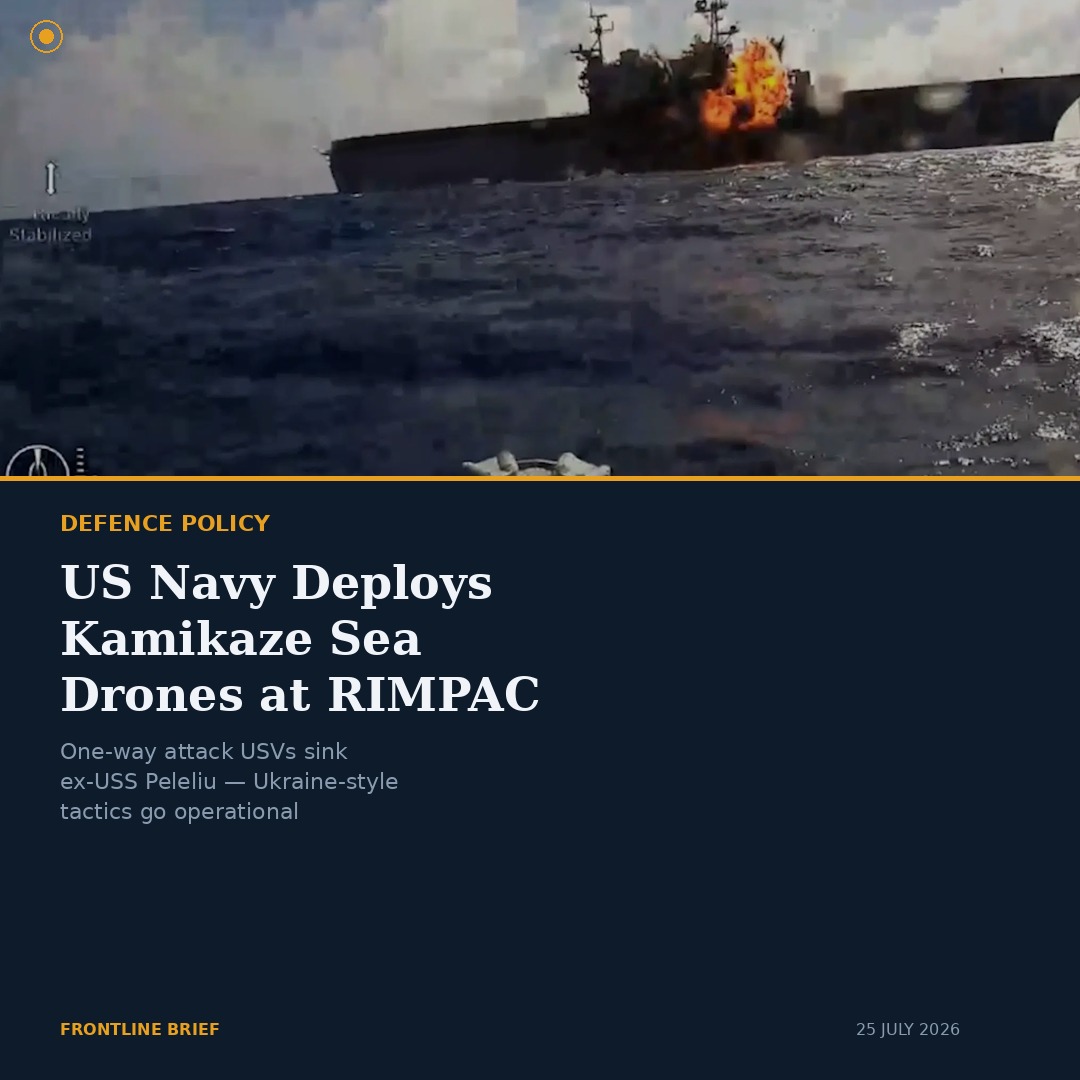
One-way attack drones at sea
Two US Navy unmanned surface vessels closed in on the decommissioned Tarawa-class amphibious assault ship USS Peleliu (LHA 5) off the coast of Hawaii on 17 July 2026, navigating past the impact holes already punched by Harpoon, Spike and LRASM missiles before detonating their warheads at the ship's waterline. The sinking exercise — conducted during the biennial, multinational Rim of the Pacific (RIMPAC) 2026 exercise — marks a critical milestone in the US Navy's drive to field autonomous attack drones across all domains: air, surface and subsurface.
RIMPAC is now classified as an Operational Test event, giving the Navy an opportunity to demonstrate advanced capabilities to allies while signalling intent to adversaries. In 2024, the exercise debuted the AIM-174B ultra long-range air-to-air missile; this year, one-way attack surface drones join the roster alongside Saildrone counter-UAS vessels and Army-Marine Corps air wing integration aboard USS Essex (LHD 2).
Lessons from the Black Sea
The capability draws directly on Ukraine's pioneering use of kamikaze maritime drones against the Russian Black Sea Fleet — attacks that sank or disabled multiple warships and fundamentally altered the naval balance in the region. Combined Task Force 66, a Europe-based US Navy unit focused on asymmetric warfighting, has closely followed Ukraine's battlefield innovations, working to enhance Ukrainian lethality while feeding lessons back into Pentagon unmanned initiatives.
Industry partners have rapidly developed several USV concepts for both the Navy and Marine Corps. The Marines have already tested similar kamikaze drones during exercises in the Philippines simulating archipelagic defence. Saronic Corsair USVs are already operational — one rescued two downed US Army Apache crewmembers over the Strait of Hormuz during combat operations, while others were subsequently used in one-way attack missions against an Iranian submarine at Bandar Abbas. The Pentagon's Drone Dominance initiatives aim to accelerate fielding with less bureaucratic friction.