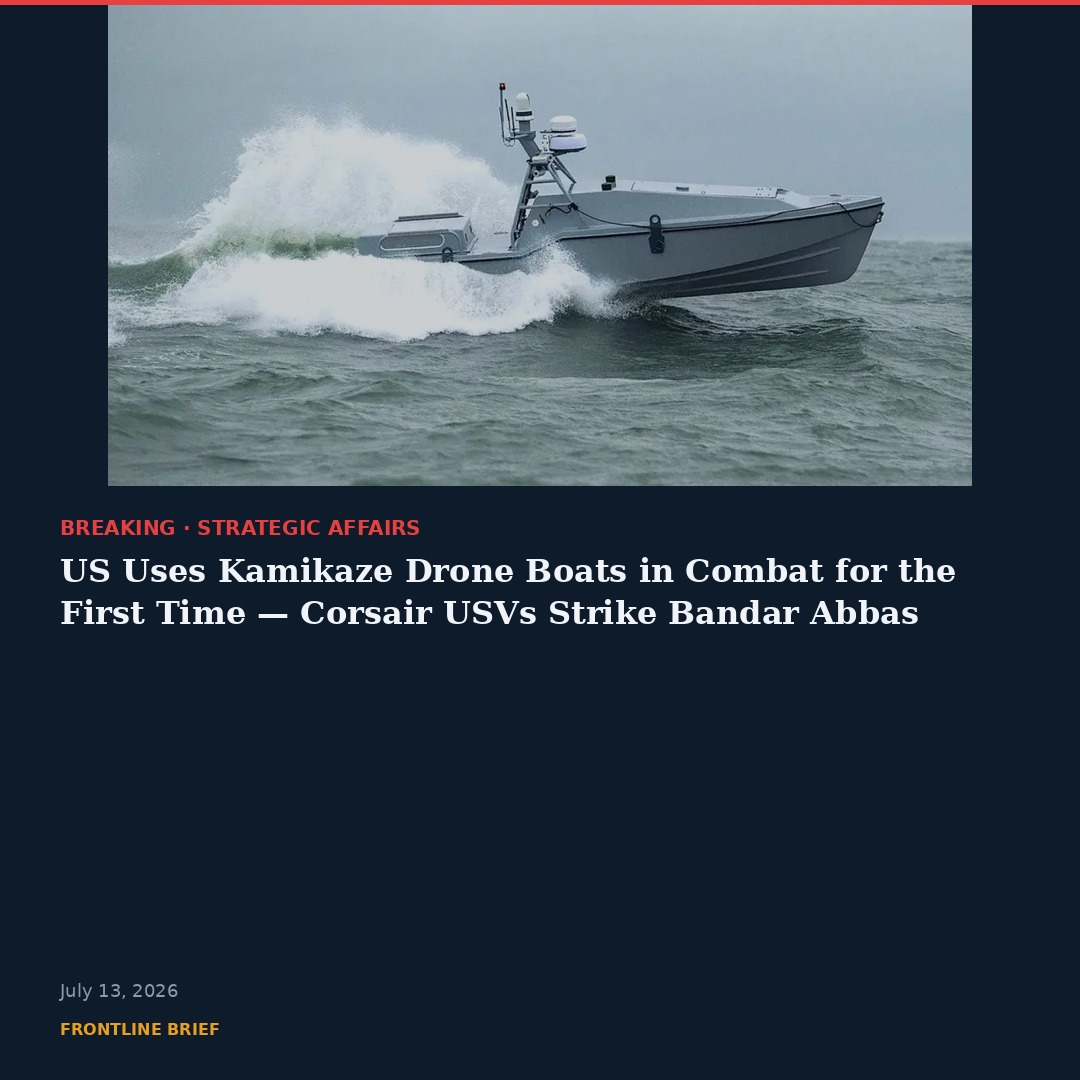
For the first time in American military history, uncrewed surface vessels were used as a strike weapon in combat. Three Saronic Corsair kamikaze drone boats struck a submarine and ship maintenance facility at Iran's Bandar Abbas Naval Base on 12 July 2026, US Central Command confirmed on X. The attack marked a historic milestone: the operational debut of a weapon class that Ukraine had already proven devastating against the Russian Black Sea Fleet, now deployed by the world's most powerful navy against a state adversary.
The Strike
CENTCOM stated that "using multiple one-way attack surface drones, CENTCOM forces successfully struck a submarine and ship maintenance facility in Iran. Three Corsair unmanned surface vessels hit the port at Bandar Abbas Naval Base, marking the first time American forces have employed sea drones in combat operations. Last night's strikes degraded Iran's ability to continue attacking commercial shipping."
The attack came as part of a broader series of strikes against "dozens" of Iranian targets during a weekend of escalating hostilities centred on control of the Strait of Hormuz. President Trump declared his intention to "take over" the strait and reinstate the naval blockade on Iranian ports.
The Corsair Platform
The Saronic Corsair is an autonomous surface vessel developed by Austin, Texas-based Saronic Technologies. Built for high-speed operations in contested maritime environments, the platform can operate autonomously or under remote human control. The Corsairs used in the Bandar Abbas strike were operated by Task Force 59 — the US Navy's testbed unit for uncrewed and AI-enabled naval capabilities in the Middle East, established in 2021 and part of the US 5th Fleet.
Task Force 59 began fielding Corsair USVs in the CENTCOM theatre in late March 2026, initially for intelligence, surveillance and reconnaissance missions in the Strait of Hormuz and Gulf of Oman. The platform's combat debut was preceded by its first operational milestone the previous month, when a Corsair rescued the crew of a US Army AH-64 Apache helicopter that was shot down by Iran over the Gulf of Oman — the first known instance of a drone boat conducting a personnel recovery mission.
The Ukrainian Precedent
The Corsair's combat use by American forces represents the adoption of a doctrine that Ukraine pioneered. Beginning in 2022, Ukrainian naval drone boats — initially improvised from jet-ski hulls and later purpose-built as the MAGURA V5 and Sea Baby platforms — systematically attacked the Russian Black Sea Fleet in port, at anchor and underway. By 2025, Ukrainian USVs had sunk or critically damaged the cruiser Moskva's successor as fleet flagship, multiple patrol vessels, a Kilo-class submarine in port, and the Kerch Strait bridge ferry. The campaign effectively denied Russia the use of western Black Sea ports for offensive operations.
The Pentagon watched closely. The Corsair programme was accelerated partly on the basis of Ukrainian operational data, and CENTCOM's decision to deploy the platform to the Gulf in March 2026 — weeks after the opening of Operation Epic Fury — was a direct response to the need for new strike vectors against Iranian naval and port infrastructure.
Strategic Implications
The combat debut of American USVs changes the calculus of maritime strike operations. A kamikaze drone boat costs a fraction of a cruise missile, can approach a target at sea level below radar coverage, and creates a new threat axis that coastal defences must now account for — in addition to aerial drones, cruise missiles, submarine-launched weapons and manned aircraft. For Iran, whose port infrastructure at Bandar Abbas is the primary base for IRGC Navy fast-attack craft and midget submarines, the demonstrated ability of USVs to strike directly into a defended harbour represents a significant new vulnerability.
For the US Navy, the Corsair strike validates a concept that has been debated for years: that cheap, expendable, autonomous surface platforms can complement — and in some scenarios replace — expensive manned systems for precision strikes against fixed coastal targets. The implications extend far beyond Iran. In a potential Western Pacific contingency, swarms of USVs could target port facilities, naval bases and logistics nodes across contested island chains — a capability that China's anti-access/area-denial strategy was not designed to counter.