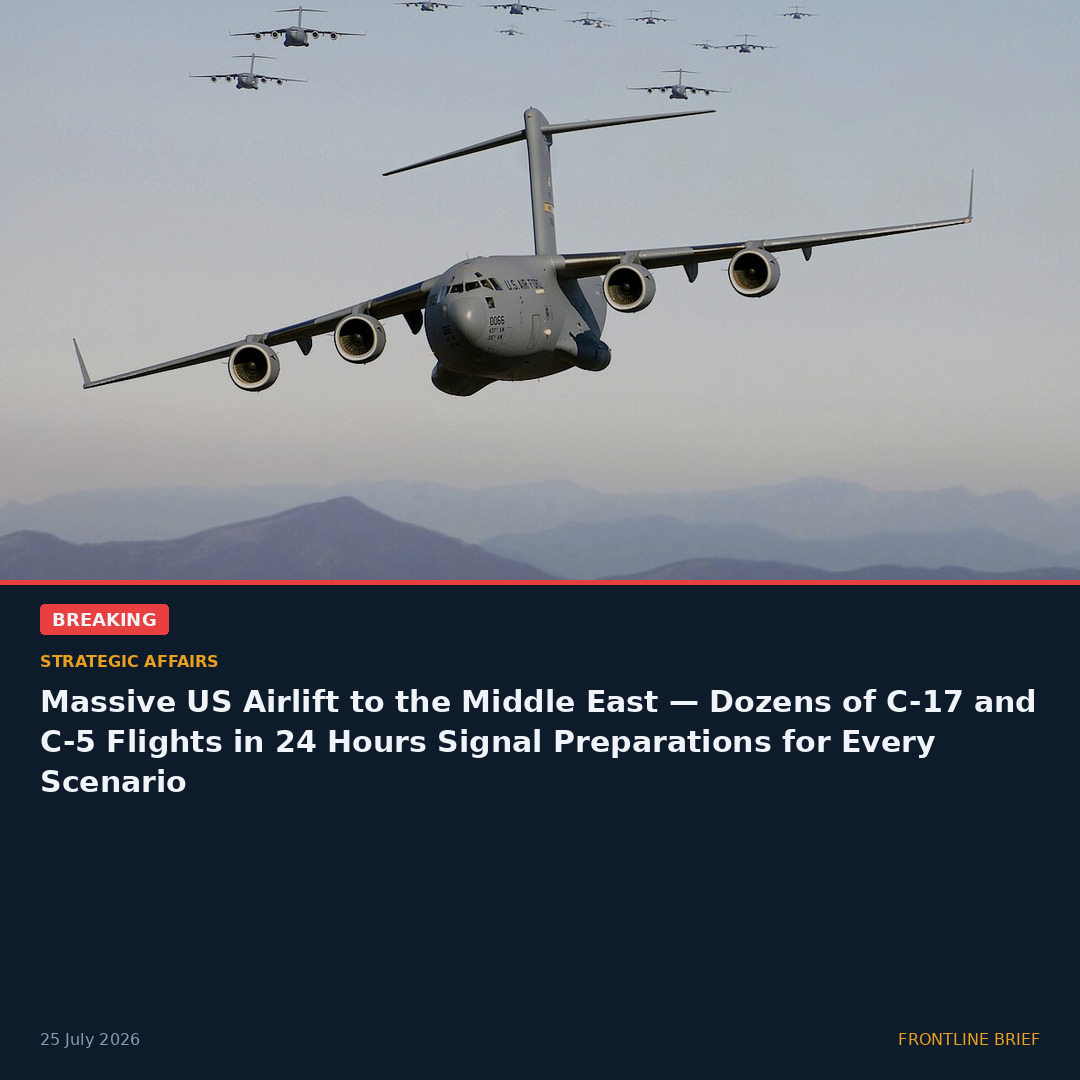
The United States has placed its forces across the Middle East on a heightened state of operational readiness, as open-source flight-tracking data reveals a dramatic surge in strategic airlift sorties over the past twenty-four hours — the largest movement of heavy cargo aircraft from Europe to CENTCOM's area of responsibility since the early days of Operation Epic Fury.
The Airlift
Dozens of US Air Force C-17 Globemaster III and C-5M Super Galaxy transport aircraft have been conducting continuous flights from European staging bases — primarily Ramstein Air Base in Germany — to forward operating locations in Qatar, Jordan, Bahrain and Saudi Arabia. The tempo is unmistakable: OSINT analysts monitoring ADS-B transponder data describe it as one of the most concentrated 24-hour windows of strategic airlift activity they have recorded this year.
According to military analysts, the cargo manifests are likely to include Patriot and THAAD air-defence battery components and interceptors, precision-guided munitions and spare parts for fifth-generation fighters (F-35A and F-22) and strike aircraft (F-15E, F-16) deployed across the region, as well as logistical support packages for the KC-135 and KC-46 aerial refuelling tankers that sustain round-the-clock combat air patrols.
Reinforcing the Bases
The airlift is no routine rotation. Washington is moving to reinforce the defensive posture of its forward bases amid continuing threats from Tehran and its network of allied militias. The timing — coinciding with Houthi naval blockade declarations against Saudi Arabia and sustained militia rocket and drone attacks against US positions in Iraq — suggests that US Transportation Command is executing contingency plans designed to ensure that American forces have the logistical depth required for a sustained, high-intensity confrontation.
The surge represents the clearest logistical signal yet that Washington is preparing the ground for every possible scenario — including a large-scale strike campaign against Iranian targets.
Three Strike Scenarios
International defence analysts note that the airlift, combined with the current force disposition, constitutes a precursor to a broader military operation that could be ordered imminently. They identify three principal target categories should the United States decide to launch what officials have described as a "massive strike":
1. Iranian energy infrastructure. The primary target would be Kharg Island, through which the overwhelming majority of Iran's crude oil exports flow. A decisive strike there would immediately deprive Tehran of its economic lifeline. The risk: Iran would almost certainly retaliate by striking Gulf states' petroleum facilities and desalination plants.
2. Direct strike on the nuclear programme. This would focus on deeply buried facilities, including the complex beneath Mount Pickaxe. Because the depth exceeds the penetration capability of even the most powerful bunker-busting munitions, analysts do not rule out special operations or strikes targeting the leadership structures and command chain of the enrichment programme.
3. Clearance of the Strait of Hormuz. An extensive operation to neutralise IRGC coastal missile batteries, fast-attack craft and radar and drone stations along the Strait. However, experts warn that even if American airpower destroys ninety per cent of the infrastructure, a residual capability in IRGC hands would be sufficient to keep shipping insurance premiums at prohibitive levels.
The Political Paradox
The most striking element of the current posture is the role of Israel. Whereas in previous escalation phases Jerusalem was the primary belligerent, this time the signal from Washington is that the United States can and will act independently. The approach leaves Israel in what analysts describe as a "calm in the eye of the hurricane" — civilian air routes continue to operate — while the broader region moves toward a potential conflagration. Critical intelligence contacts between the Mossad director and the CIA director in Washington underscore the depth of coordination behind the scenes.
With the American midterm elections approaching, the decision window for Washington is narrowing dangerously. The airlift is both a deterrence signal to Tehran and a logistical insurance policy: if diplomacy fails, the forces and supplies will already be in place.