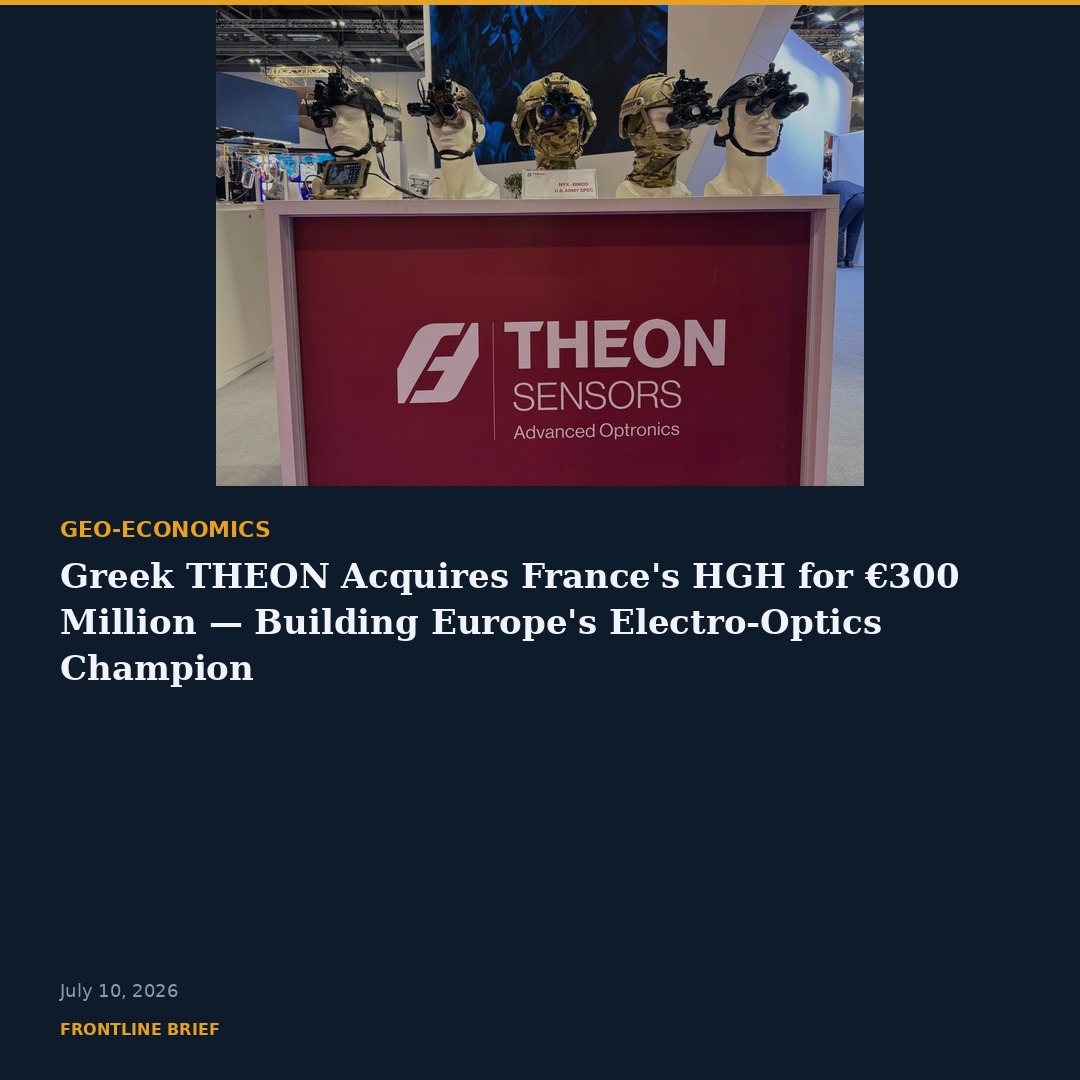
Greek defence electronics group THEON Sensors has entered into an exclusivity agreement with Carlyle Europe Technology Partners to acquire SAS Stéropès, the holding company of HGH Systèmes Infrarouges, for an enterprise value of approximately €300 million. The acquisition, first reported by France's Les Echos and confirmed by THEON on 17 June, would transform the Athens-founded company into Europe's dominant independent electro-optics house, combining night vision and thermal imaging with AI-driven wide-area surveillance and counter-drone detection.
What THEON Is Buying
HGH, founded in 1982 and headquartered in France's Optics Valley near Paris, designs and manufactures electro-optical and infrared systems for defence and civil applications. Its flagship product is the SPYNEL family of 360-degree panoramic thermal cameras, capable of continuous real-time scanning of the surrounding environment to detect threats — from dismounted infantry and small boats to low-flying drones — at extended ranges. The system is powered by CYCLOPE, HGH's proprietary AI software that automates target detection and classification without operator intervention.
Crucially, HGH's technology is ITAR-free — not subject to the US International Traffic in Arms Regulations that restrict the export of American-origin defence components. This gives the combined THEON-HGH group a significant competitive advantage in international markets where ITAR constraints have historically limited European companies that depend on US-sourced components.
The Numbers
HGH generates approximately €40 million in annual revenue, has achieved a compound annual growth rate of roughly 30 per cent since 2023, and operates with an EBITDA margin exceeding 40 per cent. At the time of the exclusivity agreement, HGH held an order backlog of approximately €70 million. THEON will acquire 100 per cent of the company at a mid-to-high-teens EV/EBITDA multiple pre-synergies, falling to approximately 10x post run-rate synergies by year two to three. The acquisition is expected to be EBITDA-margin accretive and mid-single-digit EPS accretive in 2027. Rothschild & Co is acting as sole financial advisor to THEON, with PwC handling due diligence and Bredin Prat as legal counsel. Closing is expected by Q4 2026, subject to regulatory approvals.
THEON's Acquisition Strategy
The HGH deal is the latest in a deliberate inorganic expansion that has transformed THEON from a Greek night-vision specialist into a multi-domain ISR group with global reach. Recent moves include the acquisition of Germany's Kappa Optronics, an investment in ShockEOS, a joint venture with Safran for UAS electro-optics, and the selection of THEON's PHYLAX gimbal by Rheinmetall. THEON, founded in 1997 by Christian Hadjiminas, now operates production facilities across Greece, Cyprus, Germany, the Baltics, the United States, the Gulf States, Switzerland, Denmark, Belgium, Singapore and South Korea. The group has more than 280,000 systems in service with armed and special forces in 72 countries — 26 of them NATO members — and reported an order backlog of approximately €2.4 billion at the start of 2026.
Strategic Significance
The acquisition positions THEON as a rare European defence company capable of offering an integrated electro-optics ecosystem — from man-portable night-vision devices to platform-mounted surveillance gimbals to wide-area AI-powered detection systems — under a single corporate roof and free of ITAR constraints. France becomes an AI R&D centre and export hub for the group, complementing earlier acquisitions of French firms Merio and Exosen and the Safran partnership.
For the broader European defence landscape, the deal illustrates a pattern that is reshaping the sector: mid-sized, specialist European companies are consolidating to reach the scale and product breadth needed to compete with American and Asian conglomerates, while preserving sovereign technology and ITAR-free export flexibility. THEON's trajectory — from a single-product Greek firm to a publicly listed, multi-country electro-optics champion approaching €1 billion in target revenue — is a case study in how European defence industrial sovereignty is being built from the bottom up.