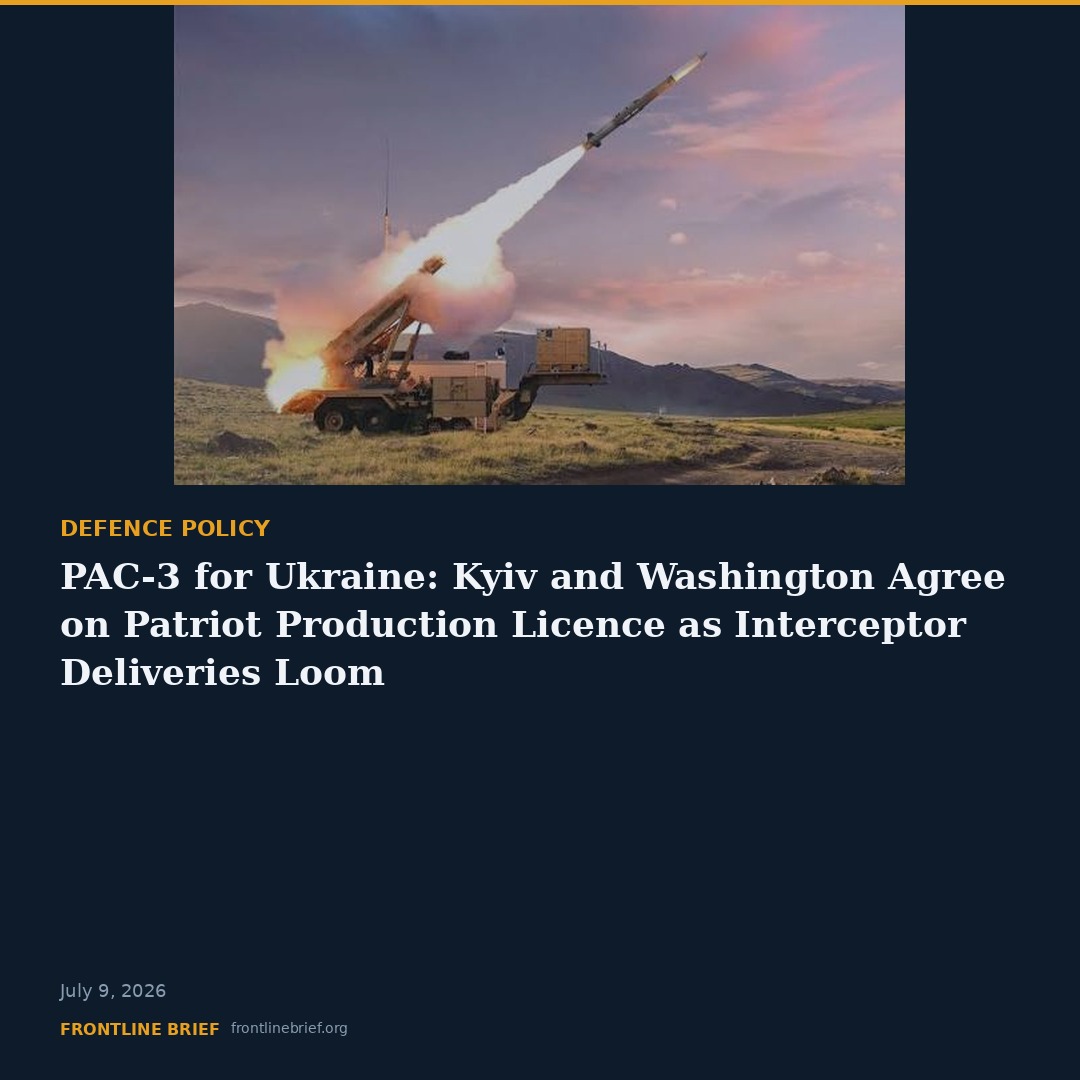
Ukraine and the United States have reached an agreement on a production licence for PAC-3 interceptors — the precision-guided missiles that arm the MIM-104 Patriot air-defence system — President Volodymyr Zelensky announced on 9 July at the conclusion of the NATO Summit in Ankara. Technical details remain to be finalised, but Zelensky made clear that the political decision has been taken and that Ukrainian and American teams should begin work immediately to secure the licence and launch production on Ukrainian territory.
Interceptors Within Days
Alongside the licence agreement, Zelensky confirmed that Ukraine will take delivery of PAC-3 interceptors from the United States within the coming days as part of a broader military-aid package. He described the Ankara summit as productive, noting separate agreements struck with European allies, though exact delivery timelines have not yet been disclosed. The PAC-3 is the most advanced variant in the Patriot family, employing hit-to-kill kinetic energy to destroy incoming ballistic missiles, cruise missiles and aircraft at ranges exceeding 30 kilometres.
Trump's Commitment
The announcement followed President Donald Trump's assurance to Zelensky on Wednesday at the NATO Summit sidelines. The American president confirmed that Washington would grant Ukraine the licence to manufacture Patriot missiles domestically — a significant departure from decades of US policy that restricted PAC-3 production exclusively to Lockheed Martin's facilities in the United States. The move reflects growing recognition that global interceptor demand far outstrips current production capacity, particularly given the rate of consumption in Ukraine's air-defence operations against Russian missile and drone barrages.
A European PAC-3 Ecosystem
The licence framework extends beyond Ukraine. Poland signed an agreement with the United States, Germany, the Netherlands and Sweden to establish a European service centre for PAC-3 interceptors. Polish Defence Minister Władysław Kosiniak-Kamysz stated that Ukrainian production could commence within weeks, though he cautioned that scaling missile manufacturing is far from simple — noting that even the United States produces Patriot interceptors at a rate that does not fully cover American requirements.
Poland is one of four NATO member states designated at the Ankara summit to receive technology-transfer authorisation for Patriot missile production and maintenance. Kosiniak-Kamysz emphasised that Warsaw would cooperate directly with Ukraine on production, positioning Poland as both a service hub and a bridge for Ukrainian manufacturing capacity.
Strategic Implications
The decision marks a watershed moment in Western air-defence policy. Until now, the PAC-3 Missile Segment Enhancement (MSE) interceptor — the current-production variant — has been manufactured solely by Lockheed Martin at its facility in Camden, Arkansas, with annual output reportedly around 500 rounds. With Ukraine consuming interceptors at a pace that threatens to exhaust allied stocks, distributed production across Europe and Ukraine is designed to increase global output while shortening supply lines to the front.
For NATO's eastern flank, the implications are immediate. A European PAC-3 ecosystem reduces dependence on transatlantic logistics, accelerates replenishment cycles, and creates an industrial base capable of sustaining operations in a prolonged conflict. For Ukraine, domestic production eliminates the delays and political uncertainties inherent in foreign deliveries, offering Kyiv a degree of self-sufficiency in one of the most critical and expensive elements of modern air defence.