The blockade holds — for now
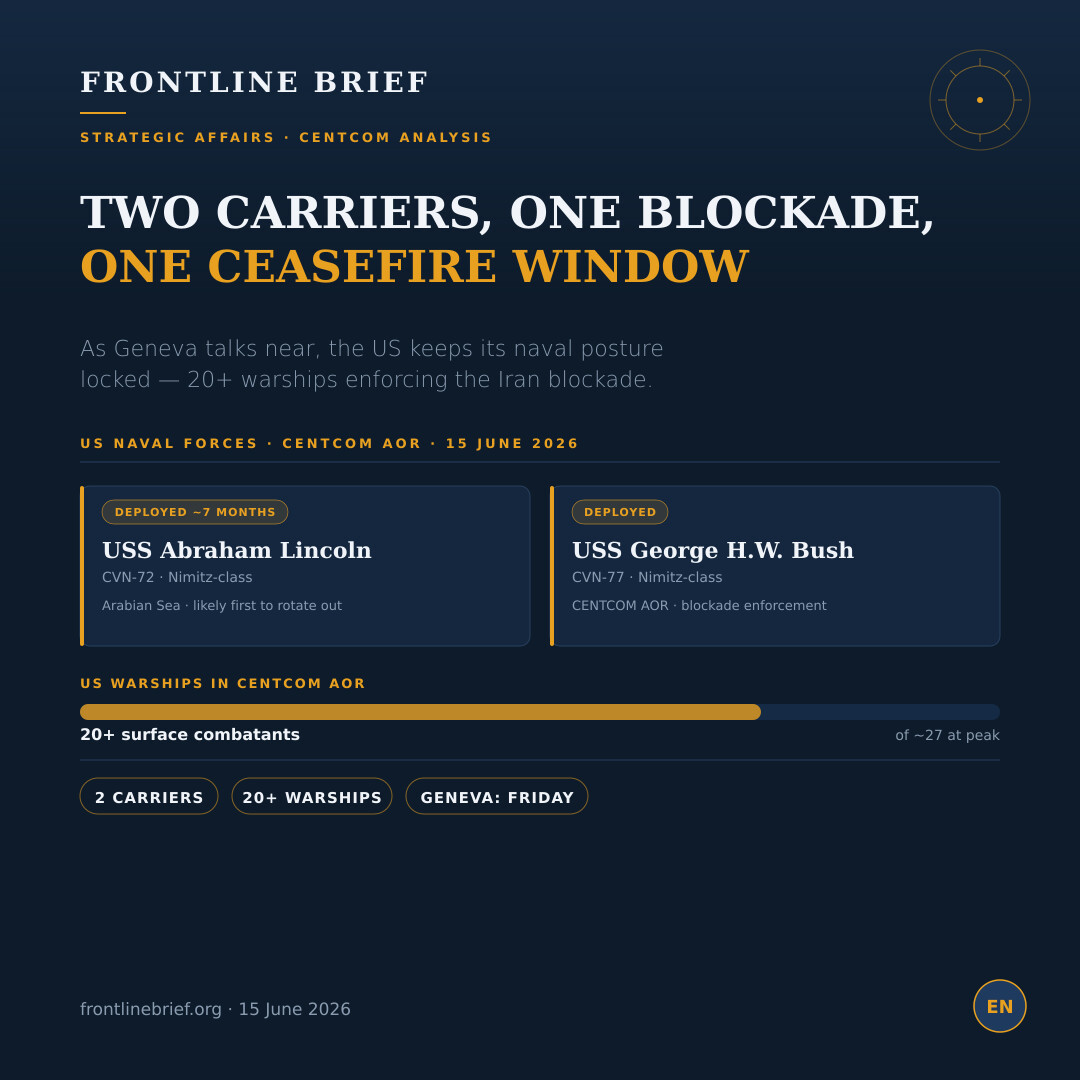
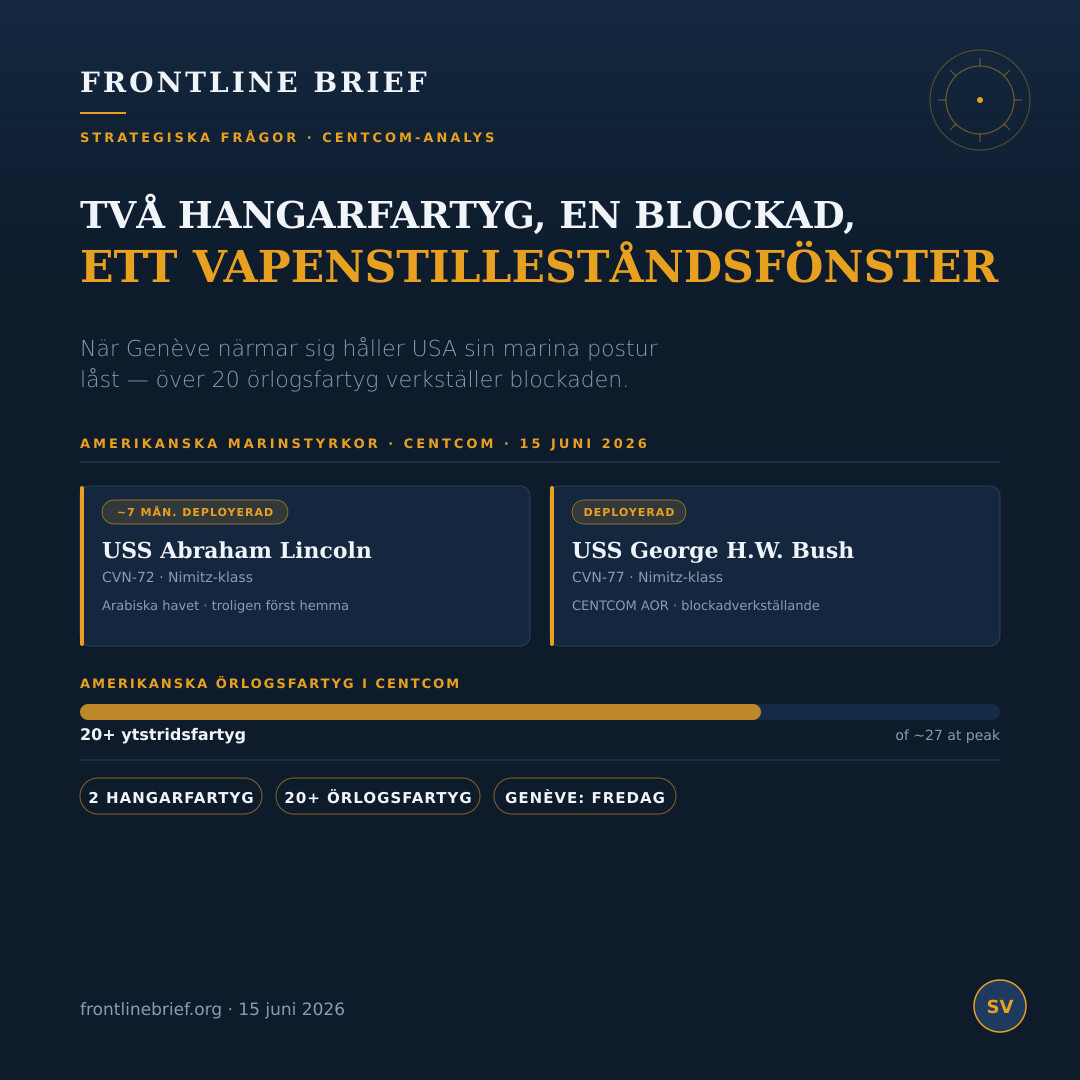
As of 15 June 2026, the US naval blockade of Iranian ports remains in full effect, according to a notice issued today by Naval Forces Central Command (NAVCENT). Two carrier strike groups — USS Abraham Lincoln (CSG-3) and USS George H.W. Bush (CSG-10) — are operating in the CENTCOM area of responsibility, supported by more than 20 surface combatants and an undisclosed number of submarines. The blockade will remain in place until the ceasefire agreement is formally executed, with the signing ceremony scheduled for Friday in Geneva.
The blockade has been in effect since 13 April 2026, imposed following the collapse of the Islamabad Talks. During that period, US forces intercepted more than 85 vessels, seized at least three ships and disabled two more. At its peak, the US had deployed three carrier strike groups simultaneously to the Middle East — the first time that had happened in decades — with USS Gerald R. Ford, USS Abraham Lincoln and USS George H.W. Bush all operating in the region, alongside more than 27 surface combatants.
What Geneva changes — and what it doesn't
The ceasefire agreement, brokered over weeks of diplomacy, commits both sides to a formal end of hostilities. But the details of the naval drawdown remain murky. The memorandum of understanding governing the ceasefire does not specify the scale or pace of the US withdrawal from the CENTCOM AOR, according to information available at the time of publication. US officials have described the drawdown plan as "conditions-based", meaning forces will not be pulled back on a fixed timetable but in response to Iranian compliance with the agreement's terms.
For the carriers themselves, the timeline is shaped by operational realities. USS Abraham Lincoln has been deployed for nearly seven months and would likely be among the first assets to rotate home — standard carrier deployments run around seven to nine months. USS George H.W. Bush is newer to the theatre. The USS Gerald R. Ford CSG, which suffered a fire and underwent repairs at Souda Bay in Crete, has already transited the Strait of Gibraltar westbound and is returning to Norfolk.
The blockade will remain in place until the ceasefire agreement is formally executed — NAVCENT notice, 15 June 2026
The broader picture: what the campaign cost and what it achieved
The 2026 Iran war began on 28 February, when the United States and Israel launched coordinated airstrikes targeting Iranian military infrastructure and senior leadership — killing Iran's Supreme Leader and a number of other officials. Iran responded with missile and drone strikes against US bases, Israeli territory and allied nations across the region, and by effectively closing the Strait of Hormuz, through which roughly 25 percent of the world's seaborne oil trade and 20 percent of global LNG flows. The economic impact of the Hormuz closure was estimated by US officials at roughly $500 million daily in costs to Iran — but the disruption to global energy markets was far more broadly felt.
The naval blockade, launched as a pressure tool after the collapse of the Islamabad ceasefire talks, added a further layer of coercion. US forces boarded and seized Iranian-flagged vessels, disabled commercial ships that violated the blockade, and conducted multiple waves of strikes against Iranian military sites — including targets in southern Iran and Tehran on 7 May, in response to Iranian attacks on US warships. The Apache helicopter shootdown that triggered the most recent escalation occurred just days before the current ceasefire framework emerged.
Eastern Mediterranean dimension
For Europe and the Eastern Mediterranean, the campaign has had significant secondary effects. The Strait of Hormuz crisis disrupted Gulf energy supplies and drove a sharp re-evaluation of European energy security. The Suez Canal route was already partially compromised by Red Sea instability before the Iran war; the combined effect on global shipping led to significant rerouting via the Cape of Good Hope. Greece's naval shipbuilding ambitions — including the Project Trident deal signed in late May — sit directly in this strategic context: a NATO ally in the Eastern Mediterranean repositioning itself as a naval hub precisely when the region's strategic importance has rarely been higher.
Ο αποκλεισμός συνεχίζεται — προς το παρόν
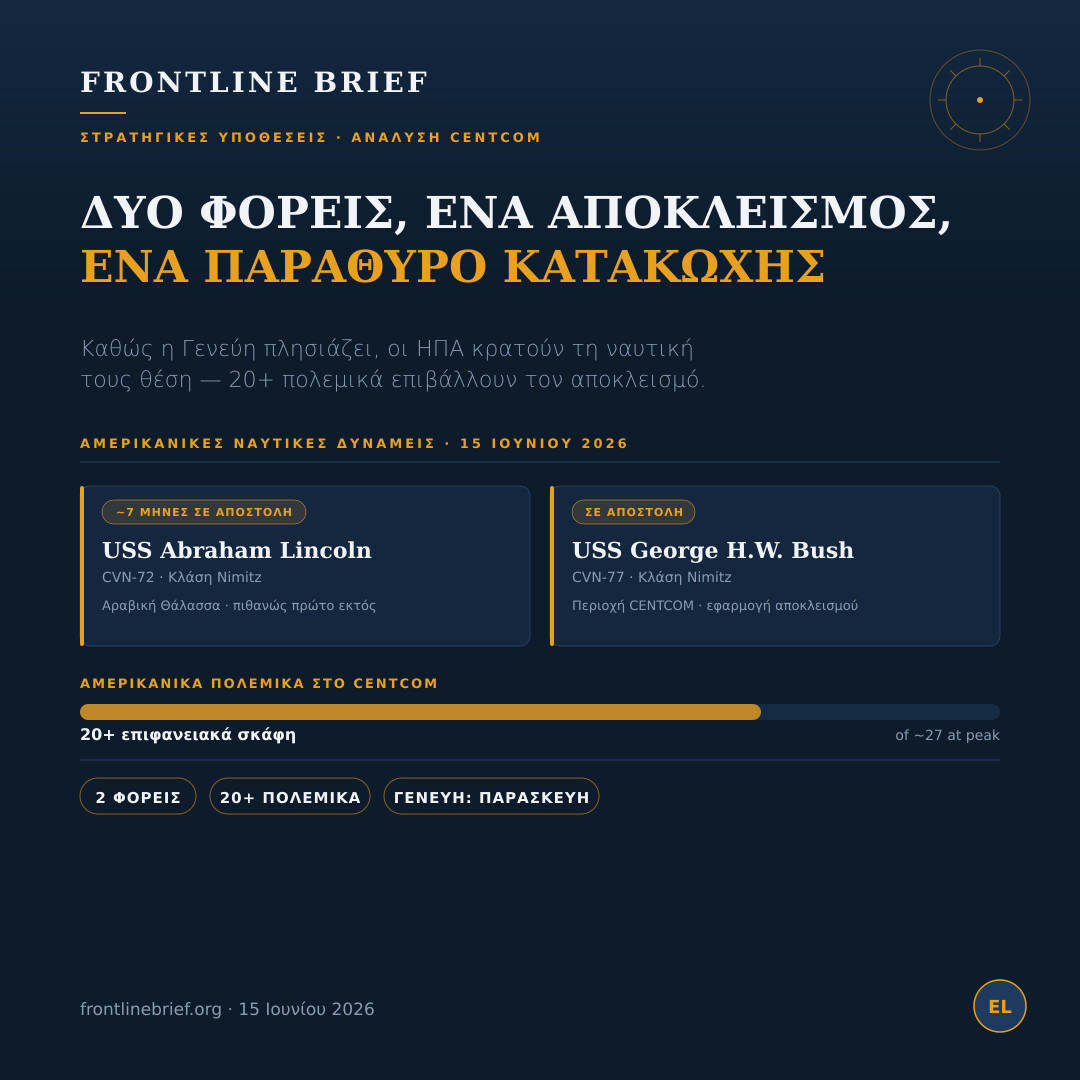
Στις 15 Ιουνίου 2026, ο αμερικανικός ναυτικός αποκλεισμός των ιρανικών λιμένων παραμένει σε πλήρη ισχύ, σύμφωνα με ανακοίνωση που εξέδωσε σήμερα η Naval Forces Central Command (NAVCENT). Δύο ομάδες κρούσης αεροπλανοφόρων — USS Abraham Lincoln και USS George H.W. Bush — επιχειρούν στην περιοχή ευθύνης του CENTCOM, υποστηριζόμενες από περισσότερα από 20 επιφανειακά σκάφη μάχης και αδιευκρίνιστο αριθμό υποβρυχίων. Ο αποκλεισμός θα παραμείνει σε ισχύ μέχρι την επίσημη υπογραφή της συμφωνίας κατακωχής, που έχει προγραμματιστεί για την Παρασκευή στη Γενεύη.
Ο αποκλεισμός ισχύει από τις 13 Απριλίου 2026, επιβλήθηκε μετά την κατάρρευση των συνομιλιών του Ισλαμαμπάντ. Αμερικανικές δυνάμεις ανέκοψαν περισσότερα από 85 πλοία, κατέσχεσαν τουλάχιστον τρία και εξουδετέρωσαν άλλα δύο. Στο αποκορύφωμά του, οι ΗΠΑ είχαν αναπτύξει τρεις ομάδες κρούσης αεροπλανοφόρων ταυτόχρονα στη Μέση Ανατολή — για πρώτη φορά εδώ και δεκαετίες.
Τι αλλάζει η Γενεύη — και τι όχι
Η συμφωνία κατακωχής δεσμεύει και τις δύο πλευρές σε επίσημη λήξη των εχθροπραξιών. Ωστόσο, οι λεπτομέρειες της ναυτικής αποχώρησης παραμένουν ασαφείς. Το μνημόνιο συναντίληψης που διέπει την κατακωχή δεν καθορίζει την κλίμακα ή τον ρυθμό αποχώρησης των αμερικανικών δυνάμεων από την περιοχή CENTCOM. Αξιωματούχοι των ΗΠΑ έχουν περιγράψει το σχέδιο αποχώρησης ως «βασισμένο σε συνθήκες» — δεν θα γίνει σε σταθερό χρονοδιάγραμμα αλλά ανάλογα με τη συμμόρφωση του Ιράν.
Το USS Abraham Lincoln έχει αναπτυχθεί εδώ και σχεδόν επτά μήνες και αναμένεται να είναι μεταξύ των πρώτων που θα επιστρέψουν. Το USS Gerald R. Ford, που υπέστη πυρκαγιά και επισκευάστηκε στη Σούδα, έχει ήδη διασχίσει τα Στενά του Γιβραλτάρ προς την Αμερική.
Ο αποκλεισμός θα παραμείνει σε ισχύ μέχρι την επίσημη εκτέλεση της συμφωνίας κατακωχής — NAVCENT, 15 Ιουνίου 2026
Η ευρύτερη εικόνα: τι κόστισε και τι επέτυχε
Ο πόλεμος του 2026 με το Ιράν ξεκίνησε στις 28 Φεβρουαρίου, όταν ΗΠΑ και Ισραήλ εξαπέλυσαν συντονισμένες αεροπορικές επιδρομές που στόχευαν στρατιωτικές εγκαταστάσεις και ηγεσία του Ιράν — σκοτώνοντας τον Ανώτατο Ηγέτη. Το Ιράν ανταπέδωσε με κλείσιμο του Στενού του Ορμούζ, μέσω του οποίου διέρχεται περίπου το 25% του θαλάσσιου εμπορίου πετρελαίου παγκοσμίως. Ο ναυτικός αποκλεισμός ήρθε ως επιπλέον πίεση, μετά την αποτυχία των διαπραγματεύσεων.
Η διάσταση της Ανατολικής Μεσογείου
Για την Ευρώπη και την Ανατολική Μεσόγειο, η σύγκρουση είχε σημαντικές δευτερεύουσες συνέπειες. Η κρίση στο Στενό του Ορμούζ διατάραξε τον ενεργειακό εφοδιασμό και οδήγησε σε εκτεταμένη εκτροπή της ναυτιλίας μέσω του Ακρωτηρίου Καλής Ελπίδας. Η Ελλάδα — με τη συμφωνία Project Trident να υπογράφεται ακριβώς σε αυτό το πλαίσιο — αναδεικνύεται ως ναυτικός κόμβος ΝΑΤΟϊκής σημασίας σε μια στιγμή που η Ανατολική Μεσόγειος δεν έχει ποτέ ήταν στρατηγικά πιο κρίσιμη.
Le blocus tient — pour l'instant
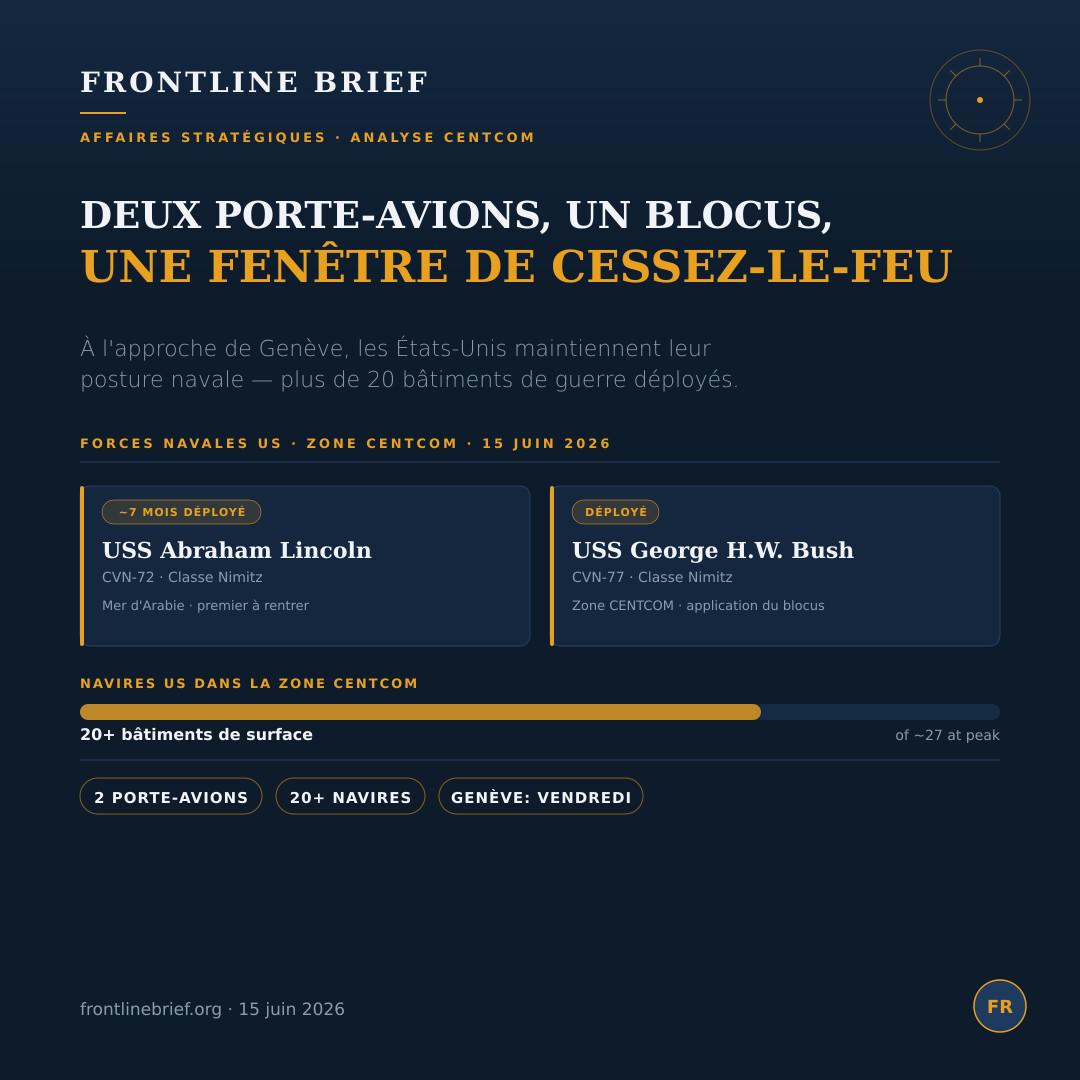
Au 15 juin 2026, le blocus naval américain des ports iraniens reste pleinement en vigueur, selon un avis publié aujourd'hui par le Naval Forces Central Command (NAVCENT). Deux groupes aéronavals — l'USS Abraham Lincoln et l'USS George H.W. Bush — opèrent dans la zone de responsabilité du CENTCOM, soutenus par plus de 20 bâtiments de surface et un nombre non divulgué de sous-marins. Le blocus restera en place jusqu'à la signature formelle de l'accord de cessez-le-feu, prévue vendredi à Genève.
Le blocus est en vigueur depuis le 13 avril 2026, imposé après l'échec des pourparlers d'Islamabad. Depuis, les forces américaines ont intercepté plus de 85 navires, saisi au moins trois bâtiments et neutralisé deux autres. À son apogée, les États-Unis avaient déployé trois groupes aéronavals simultanément au Moyen-Orient — une première en plusieurs décennies.
Ce que Genève change — et ce qu'elle ne change pas
L'accord de cessez-le-feu engage les deux parties à une fin formelle des hostilités. Mais les détails du retrait naval restent flous. Le mémorandum d'entente régissant le cessez-le-feu ne précise pas l'ampleur ni le calendrier du retrait américain de la zone CENTCOM. Des responsables américains ont décrit le plan de retrait comme "conditionné" — il ne suivra pas un calendrier fixe mais dépendra de la conformité iranienne aux termes de l'accord.
Le blocus restera en place jusqu'à l'exécution formelle de l'accord de cessez-le-feu — NAVCENT, 15 juin 2026
La dimension méditerranéenne orientale
Pour l'Europe et la Méditerranée orientale, la campagne a eu des effets secondaires importants. La crise du détroit d'Ormuz a perturbé les approvisionnements énergétiques du Golfe et entraîné un important détournement du trafic maritime via le cap de Bonne-Espérance. La Grèce — avec l'accord Project Trident signé fin mai — se positionne précisément dans ce contexte stratégique comme un hub naval de l'OTAN, à un moment où la Méditerranée orientale n'a rarement été aussi décisive.
Blokaden holder — indtil videre
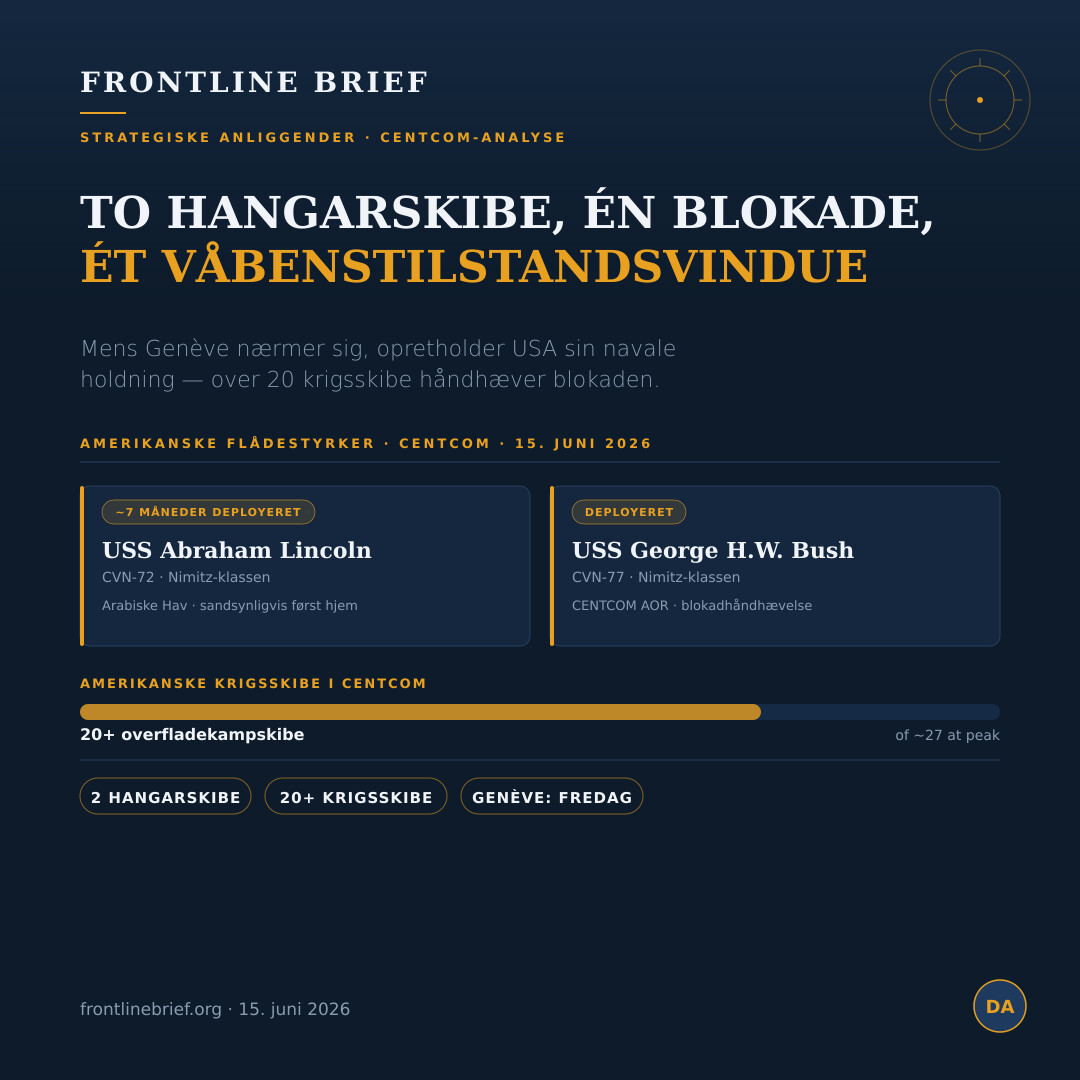
Den 15. juni 2026 er den amerikanske flådeblokade af iranske havne stadig fuldt ud i kraft, ifølge en meddelelse udsendt i dag af Naval Forces Central Command (NAVCENT). To hangarskibsstrikegrupperne — USS Abraham Lincoln og USS George H.W. Bush — opererer i CENTCOM's ansvarsområde, støttet af over 20 overfladekampskibe og et uoplyst antal ubåde. Blokaden vil forblive på plads, indtil våbenstilstandsaftalen er formelt underskrevet, med signeringsceremoni planlagt til fredag i Genève.
Blokaden har været i kraft siden den 13. april 2026. Amerikanske styrker har siden da afskåret mere end 85 fartøjer, beslaglagt mindst tre skibe og neutraliseret to andre. På sit højdepunkt havde USA deployeret tre hangarskibsstrikegrupperne samtidigt i Mellemøsten — første gang i årtier.
Blokaden vil forblive på plads, indtil våbenstilstandsaftalen er formelt underskrevet — NAVCENT, 15. juni 2026
Den østlige Middelhavsvinkel
For Europa og det østlige Middelhav har kampagnen haft betydelige sekundære virkninger. Hormuz-krisen forstyrrede Golfens energiforsyninger og førte til en storstilet omdirigering af skibsfarten via Kap det Gode Håb. Grækenland — med Project Trident-aftalen underskrevet i slutningen af maj — positionerer sig netop i denne strategiske kontekst som et NATO-marinenav på et tidspunkt, hvor det østlige Middelhav sjældent har været vigtigere.
Blockaden håller — för nu
Den 15 juni 2026 är den amerikanska sjöblockaden av iranska hamnar fortfarande fullt i kraft, enligt ett meddelande utfärdat idag av Naval Forces Central Command (NAVCENT). Två hangarfartygsstridsgrupper — USS Abraham Lincoln och USS George H.W. Bush — opererar i CENTCOM:s ansvarsområde, stöttade av över 20 ytstridsfartyg och ett okänt antal ubåtar. Blockaden kommer att förbli på plats tills vapenstilleåndsavtalet formellt undertecknas, med signeringsceremoni planerad till fredag i Genève.
Blockaden har varit i kraft sedan den 13 april 2026. Amerikanska styrkor har sedan dess avskurit fler än 85 fartyg, beslagtagit minst tre skepp och neutraliserat ytterligare två. På sin höjdpunkt hade USA deployerat tre hangarfartygsstridsgrupper simultant i Mellanöstern — första gången på decennier.
Blockaden förblir på plats tills vapenstillståndsavtalet formellt undertecknas — NAVCENT, 15 juni 2026
Det östra Medelhavsperspektivet
För Europa och östra Medelhavet har kampanjen haft betydande sekundära effekter. Hormuz-krisen störde Golfens energileveranser och ledde till en storskalig omdirigering av sjöfarten via Godahoppsudden. Grekland — med Project Trident-avtalet undertecknat i slutet av maj — positionerar sig i exakt detta strategiska sammanhang som ett Nato-marinnav vid ett tillfälle då östra Medelhavet sällan har varit viktigare strategiskt.