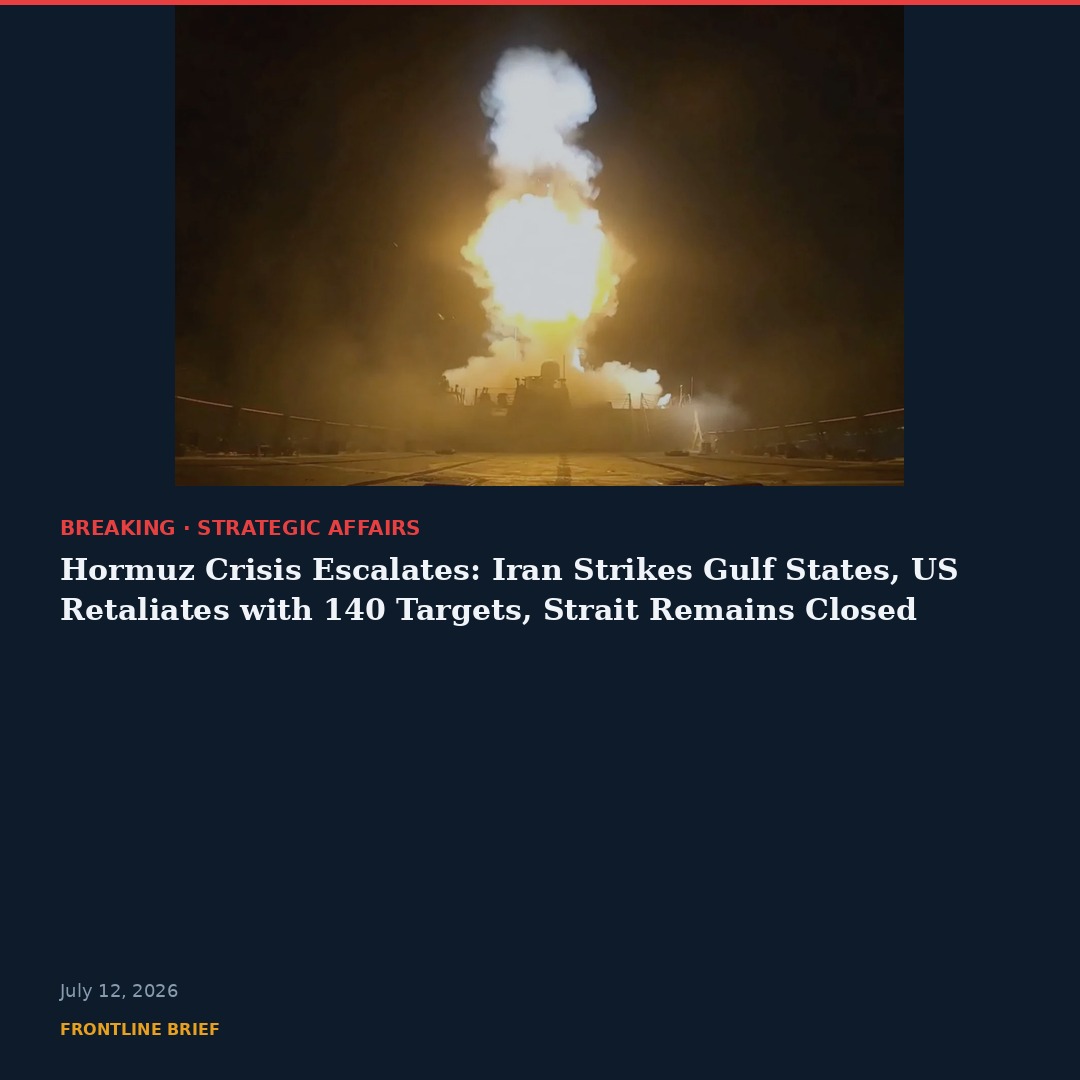
The crisis in the Strait of Hormuz entered its most dangerous phase on the weekend of 11–12 July 2026, as Iran launched strikes against Qatar, Kuwait, Bahrain, Jordan and the United Arab Emirates in retaliation for US attacks that hit approximately 140 Iranian military targets — including, for the first time, the strategic oil export hub of Kharg Island. The strait itself remains closed under what Iran describes as a 30-day period of "total oversight and management," with the IRGC warning that any new developments will delay reopening and raise escalation.
The Trigger
The latest escalation was triggered by an Iranian attack on a Cyprus-flagged container ship transiting the Strait of Hormuz, which suffered significant engine-room damage and was set ablaze. One crew member — an Indian national — remains missing. The IRGC described the action as a "warning shot" against a vessel using an "unauthorised route." US Central Command responded with strikes on approximately 140 Iranian targets, including air defences, drone storage facilities, cruise missile sites, targeting radars, minelaying capabilities and surface-to-air missile systems.
Iran's Retaliation
Iran responded by launching missiles and drones against US-allied targets across the Gulf. The IRGC struck Prince Hassan Air Base in Jordan, claiming to have destroyed a command-and-control centre and drone hangars. Missile alerts sounded across Qatar, Kuwait, Bahrain and the UAE. Qatar's Ministry of Defence confirmed it intercepted incoming Iranian fire. Kuwait reported one fatality and more than sixty injuries from intercepted debris. Bahrain banned its citizens from travelling to Iran and Iraq.
The attacks on Qatar were particularly significant: Doha had been hosting US-Iran mediation talks, and Iran's decision to target a mediator state signals that the diplomatic track has effectively collapsed. Iran's chief negotiator Ghalibaf posted on X that "America still hasn't learned that bullying and breaking promises are no longer cost-free."
Diplomatic Efforts
Oman has emerged as the primary intermediary. Iranian Foreign Minister Araghchi met his Omani counterpart on Saturday, with Oman drafting a tentative proposal to manage traffic in the strait through two separately controlled routes. Pakistan — a key intermediary during earlier US-Iran talks — called on Iran to exercise restraint, while Saudi Arabia has been rerouting oil exports via the Red Sea port of Yanbu to bypass the closed strait. The foreign ministers of Saudi Arabia and Pakistan expressed "deep concern" in a joint call.
Iran's new Supreme Leader Mojtaba Khamenei, in his first public statement since his father Ayatollah Ali Khamenei's funeral, vowed that Iranians would avenge his killing in the war's opening strikes on 28 February. US officials attributed the renewed hostilities to what they described as "a rogue faction of Iranian hard-liners" attempting to sabotage ceasefire negotiations.
Energy Impact
The Strait of Hormuz handles approximately 20 per cent of global oil trade. Iran's de facto closure has forced Persian Gulf exporters to seek alternative routes, with Saudi Arabia diverting crude via Yanbu and Pakistan requesting Red Sea rerouting. Brent crude jumped 5.6 per cent above $78 following the Kharg Island strikes. CENTCOM reported that US forces had redirected 94 commercial vessels and disabled four while enforcing a blockade to prevent commerce into and out of Iranian ports. Japan's refiners, who receive approximately 70 per cent of their Middle Eastern crude through Hormuz, have requested government stockpile releases.
Strategic Implications
The Hormuz crisis has become the defining strategic confrontation of 2026. Iran's ability to close the world's most critical energy chokepoint — even temporarily — demonstrates a vulnerability that decades of US naval supremacy in the Gulf were supposed to prevent. The strikes on Kharg Island represent a significant escalation: targeting Iran's primary revenue source crosses a threshold that previous administrations had avoided. For the Gulf states, the Iranian strikes on their territory have shattered the assumption that remaining neutral in a US-Iran conflict would provide protection. The region is now in a cycle of strikes and counter-strikes with no clear off-ramp, and the diplomatic track — already fragile — has been further damaged by Iran's targeting of mediator states.