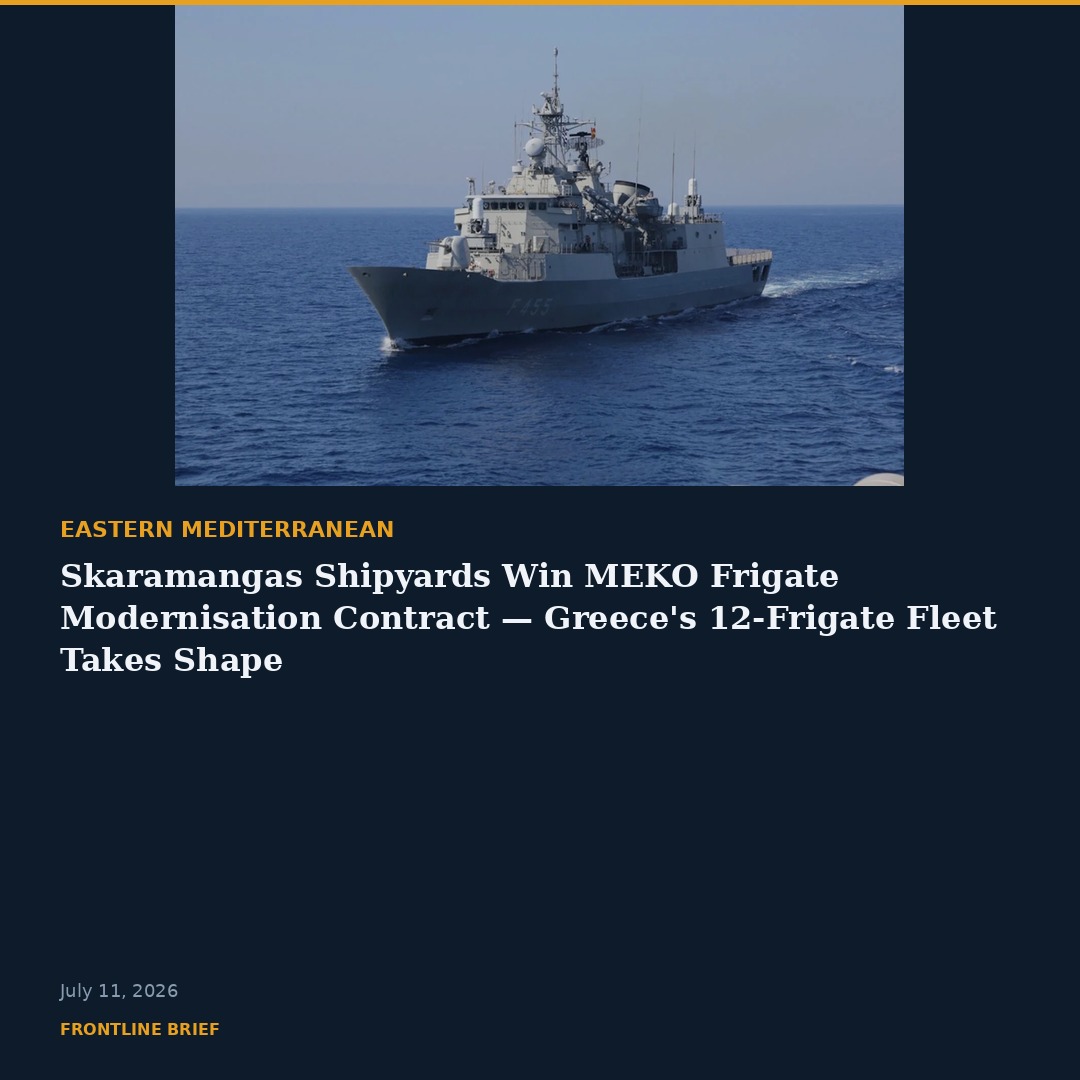
Skaramangas Shipyards has signed a contract with the Greek Ministry of National Defence for specialised naval and electromechanical works on the Hellenic Navy's four MEKO 200HN Hydra-class frigates, completing the final pillar of a modernisation programme that will extend the vessels' operational lives by approximately 15 years. The contract, valued at €19 million, was reviewed by the Hellenic Parliament's Defence Equipment Programmes Committee on 5 May 2026 and subsequently approved by the Supreme Council for National Defence (KYSEA).
Three Pillars of Modernisation
The MEKO upgrade programme rests on three interlocking contracts. The first, signed with Thales Nederland, provides the technological backbone: the TACTICOS II combat management system, the NS100 AESA radar and the STIR 1.2 EO Mk2 fire-control system — a comprehensive sensor and C2 overhaul that replaces ageing analogue systems with a fully digital, network-enabled combat architecture. The second, signed with Greek defence integrator SSMART, covers system installation, integration, commissioning, configuration and certification aboard the frigates. The third — the Skaramangas contract now signed — covers the structural modifications, CIC reconfiguration and electromechanical works required to physically accommodate the new electronics.
Particular emphasis has been placed on synchronising the shipyard schedule with the delivery timeline for the electronic equipment, minimising the time each frigate spends in the yard and preserving fleet availability throughout the programme. The MEKO frigates were originally built at Skaramangas, making the shipyard a natural choice for work that demands intimate knowledge of the vessels' internal architecture.
The 12-Frigate Fleet
The MEKO modernisation is one element of a broader restructuring that will give the Hellenic Navy a standardised 12-frigate surface fleet for the first time in its modern history. The planned force combines three classes: four FDI HN frigates (the Kimon class, built in France by Naval Group, armed with Aster 30 missiles and optimised for area air defence); four FREMM Bergamini-class frigates acquired from the Italian Navy (approved by KYSEA on 18 May 2026, with the first two hulls expected between 2029 and 2030, at a cost of €500–700 million); and the four upgraded MEKO 200HN frigates now entering modernisation at Skaramangas.
This 12-frigate structure is designed to standardise logistics, missile inventories, maintenance procedures and operational doctrine across three complementary platforms — providing layered air defence, anti-submarine warfare and sea-control capability across the Aegean, Eastern Mediterranean and international deployment commitments.
Industrial Sovereignty
The Skaramangas contract reflects Defence Minister Nikos Dendias' directive requiring at least 25 per cent domestic industrial participation in all armed forces procurement programmes. By assigning the shipyard work to Skaramangas — now under the management of CEO Miltiadis Varvitsiotis — Athens reinforces the yard's role as a strategic pillar of Greece's indigenous defence industrial base. The modernisation programme creates employment and sustains skills in warship construction and maintenance at a time when the yard is also positioning itself for future Greek naval programmes.
Strategic Significance
The four Hydra-class frigates remain frontline operational units with heavy commitments across the Aegean and Eastern Mediterranean. As the older Elli-class frigates approach end of life and the new FDI vessels raise the capability standard, the MEKO modernisation ensures there is no capability gap in the transition. With TACTICOS II, the NS100 AESA radar and modern fire-control systems, the upgraded MEKOs will operate on a digital architecture compatible with the FDI and FREMM frigates — enabling network-centric operations across the entire surface fleet.
Greece's €28 billion defence modernisation framework (2025–2036) positions the Hellenic Navy for a generational transformation. The MEKO upgrade, the FREMM acquisition, the FDI programme and the national strategy for unmanned vehicles together represent the most ambitious naval recapitalisation in Greek history — and a decisive signal that Athens intends to remain the dominant naval power in the Eastern Mediterranean.