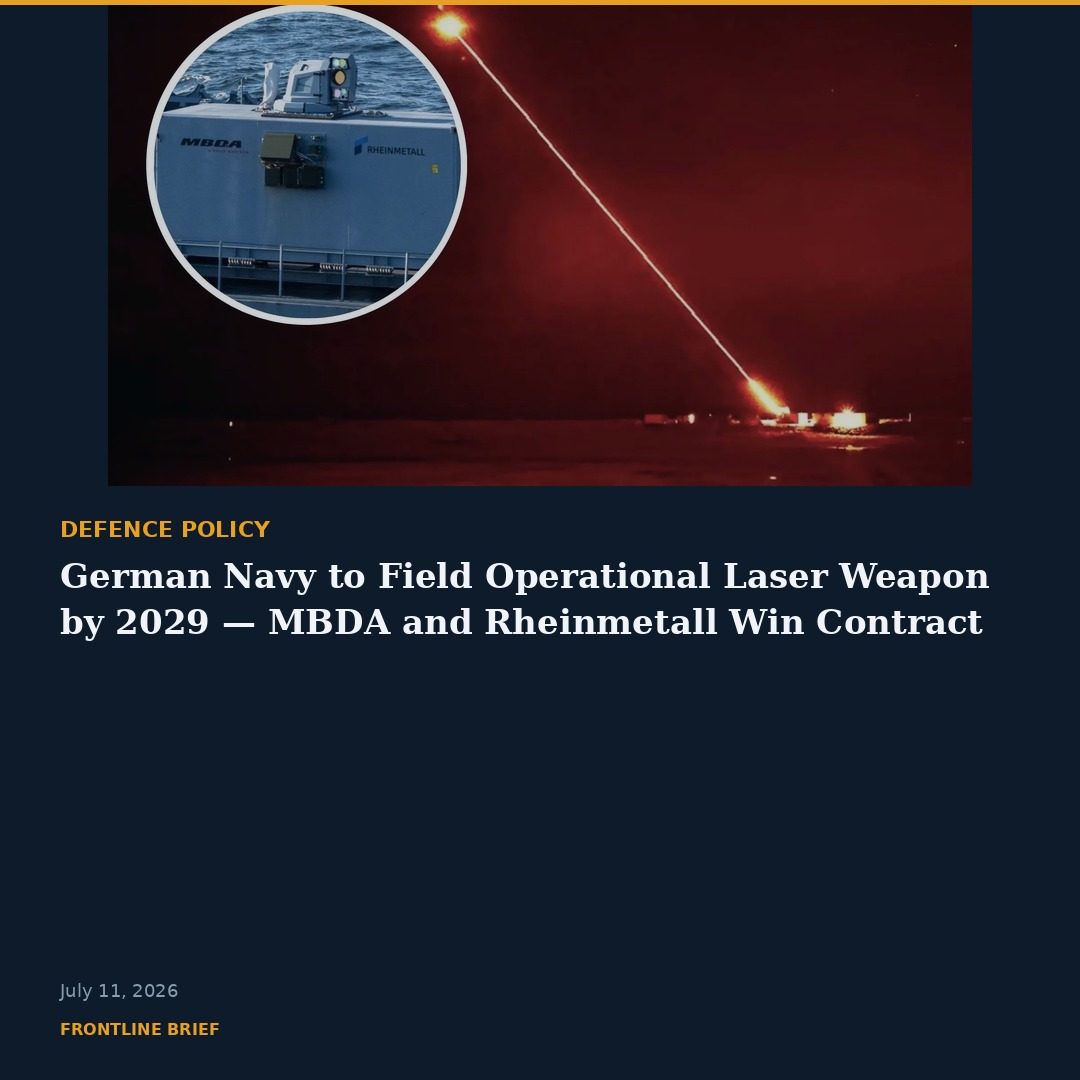
The German Federal Office of Bundeswehr Equipment (BAAINBw) has signed a contract with the High-Energy Laser Naval Demonstrator Working Group (ARGE HEL) — a joint venture being formed between MBDA Deutschland and Rheinmetall Waffe Munition — for the development of a high-energy laser weapon system for the German Navy. The contract, signed on 9 July 2026, is valued in the mid three-digit million-euro range and aims to deliver an operational system by 2029.
Proven at Sea
The laser weapon system is not starting from scratch. A naval demonstrator has already accumulated 28,000 nautical miles of sea trials aboard the Sachsen-class frigate FGS Sachsen, operating across the North Sea, Baltic Sea and Mediterranean. Over the course of more than a year of testing at the Bundeswehr Technical Centre for Weapons and Ammunition (WTD 91) in Meppen, the system fired more than 1,000 shots against airborne, maritime and land-based targets, proving its effectiveness in adverse weather conditions.
The demonstrator's refined beam quality and tracking capability allow the laser energy to be focused with extreme precision — onto an area measuring just a few centimetres — even on moving targets. This high energy density means targets can be engaged more quickly, more precisely and more effectively while consuming less laser power than broader-beam alternatives.
The System
The contract covers a complete system for maritime applications, encompassing the entire operational chain from reconnaissance and target tracking through to engagement. The system is containerised, meaning it can be deployed not only on warships but also for port security and other force-protection applications. The primary use case is counter-drone operations — neutralising unmanned aerial systems that conventional kinetic defences struggle to engage cost-effectively.
Roman Koehne, Head of Rheinmetall's Weapon and Ammunition Division, described the contract as a demonstration of what can be achieved when two leading system houses combine complementary capabilities. Thomas Gottschild, Managing Director of MBDA Deutschland, emphasised the system's cost-efficiency and its potential for port security applications beyond the naval role.
Sovereign Technology
The joint venture is placing particular emphasis on German supply chains and domestic systems expertise, reflecting a broader push within the Bundeswehr to secure national sovereignty in critical defence technologies. Series production will largely take place in Germany, creating training and employment opportunities in the high-energy weapons sector — a field where the United States, Israel and the United Kingdom have made significant investments but where continental European programmes have lagged.
Strategic Implications
The German Navy's laser weapon programme addresses a gap that the drone age has made acute: the cost-exchange ratio of using missile-based defences against cheap unmanned systems. A single RAM or ESSM missile costs hundreds of thousands of euros; a laser shot costs a fraction of that, with an effectively unlimited magazine as long as the ship has electrical power. For sustained operations against drone swarms — the threat that now dominates naval force-protection planning — directed energy offers a fundamentally different economics of defence.
Germany's decision to move from demonstrator to operational procurement also signals to NATO allies that European navies are no longer content to watch American and Israeli directed-energy programmes from the sidelines. With the UK's DragonFire programme progressing in parallel and France investing in its own laser systems, a European high-energy weapon industrial base is beginning to take shape — one that could, within the next decade, make directed-energy counter-drone systems as standard as CIWS mounts on Western warships.