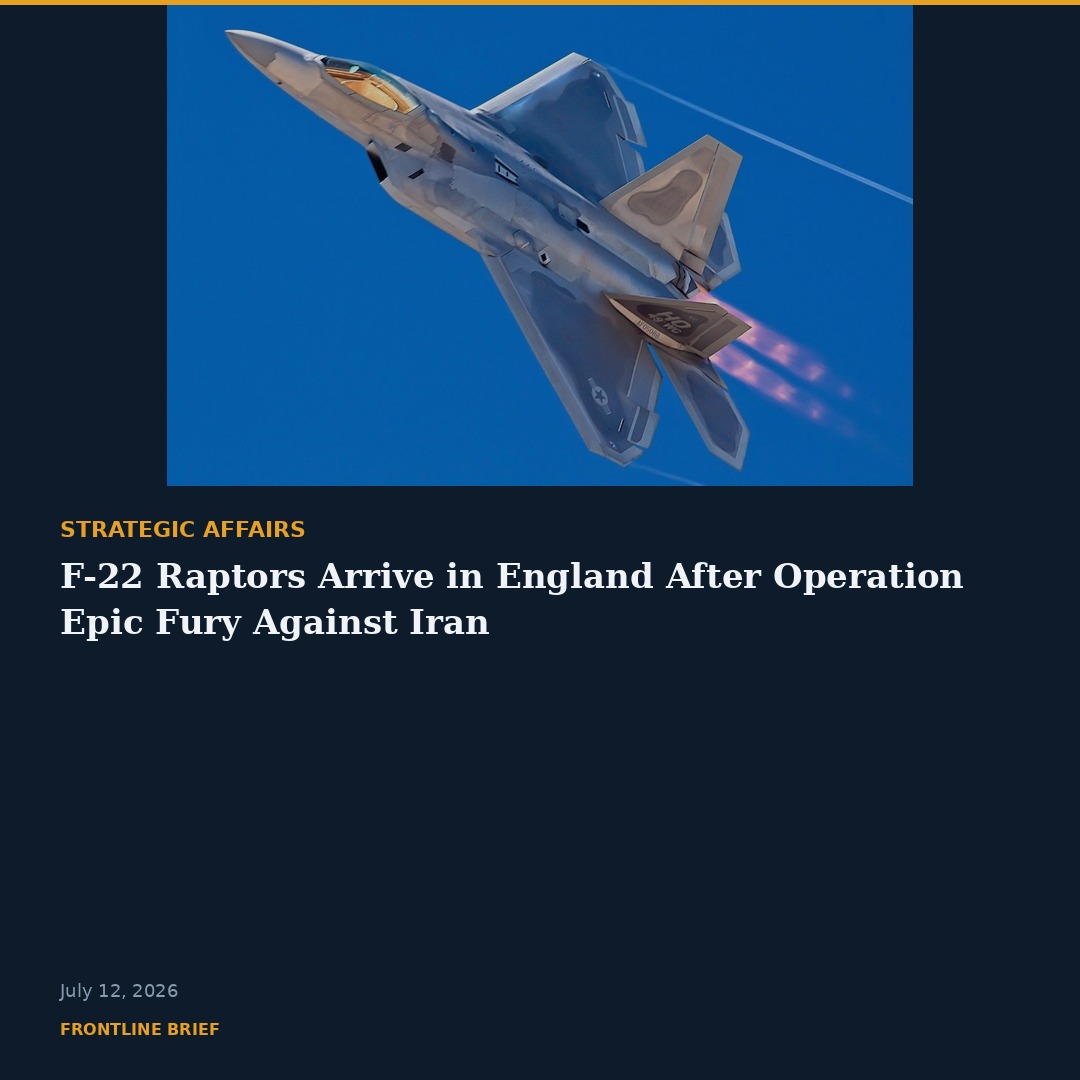
Ten United States Air Force F-22 Raptors from the 1st Fighter Wing at Langley Air Force Base arrived at RAF Fairford in the United Kingdom on Friday morning, completing a redeployment from Ovda Air Base in southern Israel where the jets had been stationed since late February as part of Operation Epic Fury — the American-led air campaign against Iran.
Operation Epic Fury
The F-22s played a decisive role in the opening phase of the campaign. On 1 March, Raptors executed the first suppression missions, neutralising Iranian S-300PMU-2 and domestically produced Bavar-373 long-range surface-to-air missile batteries to clear corridors for follow-on coalition strike aircraft entering defended airspace. Between 1 and 9 March, the stealth fighters flew more than 200 combat sorties while — according to US Central Command's own assessment — remaining undetected by Iranian radar networks throughout the operation.
Targets included infrastructure connected to Iran's nuclear programme, command nodes linked to the Islamic Revolutionary Guard Corps (IRGC), and integrated air defence sites. The F-22's low-observable design and advanced sensor fusion allowed it to penetrate the deepest layers of Iran's air defence network and deliver precision-guided weapons against strategic facilities that conventional fourth-generation aircraft could not have reached without unacceptable risk.
The Retrograde
The move to Fairford is part of a broader retrograde of American airpower from the CENTCOM region. On 1 July, B-52H Stratofortress bombers departed Fairford after their own Epic Fury forward deployment. Other tactical fighter packages have rotated home, with some being replaced and others not. RAF Fairford serves as a primary hub for transatlantic US military aircraft movements, and the F-22s arrived in three waves supported by KC-135 Stratotanker aerial refuelling aircraft.
The drawdown is occurring against a backdrop of rising tensions. Renewed exchanges between US and Iranian forces have stretched into a third day, raising the prospect that the air campaign's pause may prove temporary. The positioning of the F-22s at Fairford — rather than their return to Langley — keeps the Raptors within rapid redeployment range of the Middle East should hostilities resume.
The F-22's Combat Debut
Operation Epic Fury represented the F-22 Raptor's most intensive combat deployment since its first use in Operation Inherent Resolve against Islamic State targets in Syria in 2014. The Iran campaign demonstrated capabilities that had been theorised but never validated at scale in a contested, peer-level air defence environment: sustained SEAD operations against modern Russian-origin and indigenous missile systems, deep penetration strikes against hardened targets, and continuous operations over defended airspace without a single engagement by enemy air defences.
For the US Air Force, the campaign provided the institutional validation that the Raptor's stealth, supercruise and sensor fusion offer a qualitative advantage that no other platform in the Western inventory can replicate — and that the aircraft remains operationally indispensable even as the service prepares to transition to the Next Generation Air Dominance (NGAD) programme.
Strategic Implications
The F-22's performance against Iran's air defences carries implications that extend well beyond the Middle East. For countries operating Russian-origin air defence systems — including those in potential contingencies in the Western Pacific and Eastern Europe — the demonstrated ability of a stealth fighter to suppress S-300-class systems and operate with impunity sends a clear deterrent signal. For Iran, the campaign exposed the limits of a layered air defence architecture that had been presented as capable of denying access to Iranian airspace.
The positioning at Fairford also underscores the UK's role as a critical forward operating base for US power projection — a function that has taken on renewed significance as Washington manages simultaneous strategic commitments across the Middle East, Europe and the Indo-Pacific.