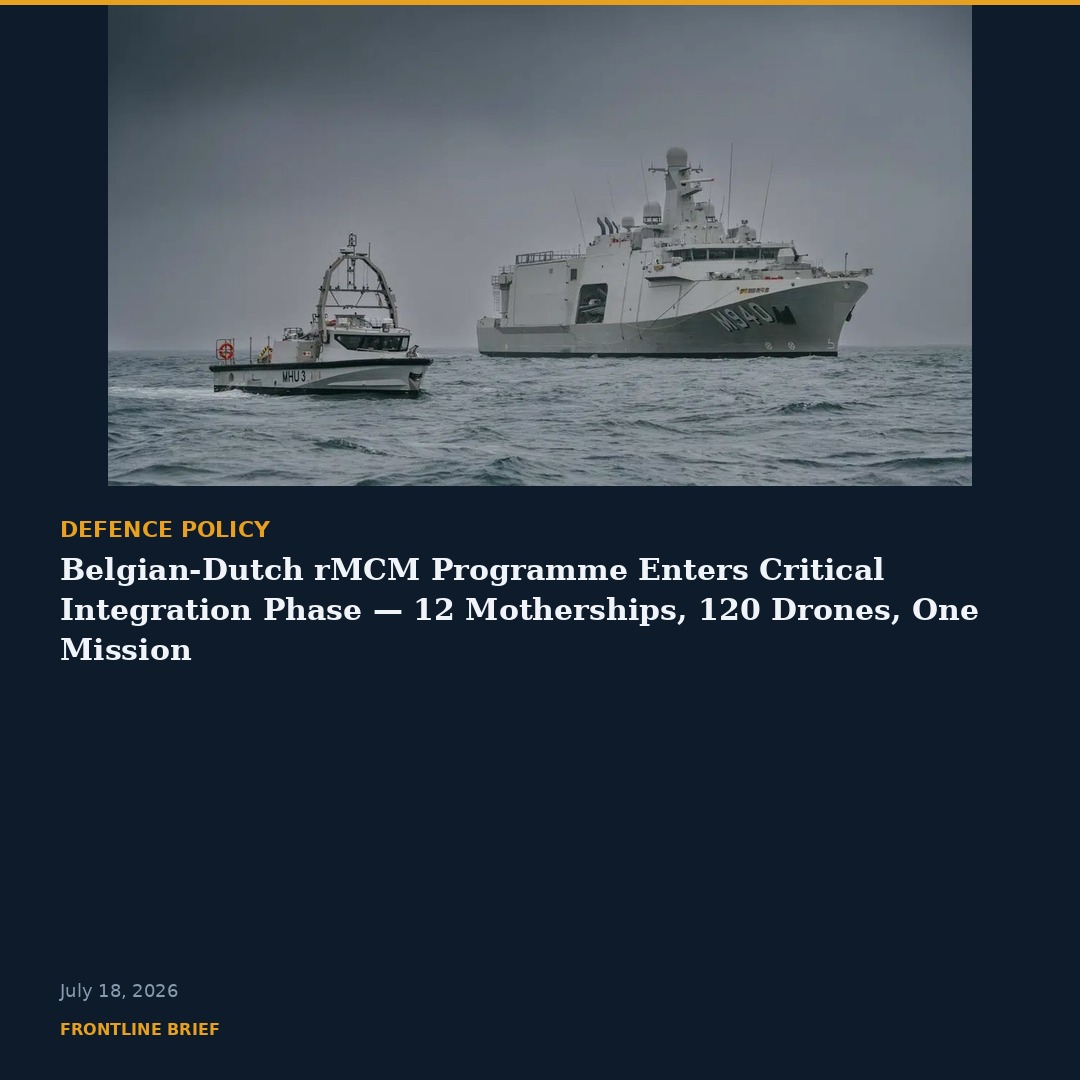
The joint Belgian-Dutch replacement Mine Countermeasures (rMCM) programme — Europe's most ambitious autonomous naval mine warfare initiative — has entered its critical integration phase, with the Belgian Navy's lead ship Oostende (M940) now conducting sea trials with unmanned systems embarked for the first time. The programme aims to demonstrate full stand-off mine warfare capability before the end of 2026.
The Programme
Awarded in 2019 to Belgium Naval & Robotics — a consortium of Naval Group and Exail — the rMCM programme covers 12 dedicated MCM motherships (six for each navy) and approximately 120 unmanned systems designed to detect, classify, identify and neutralise naval mines without the mothership entering the danger zone. The ships are built by Kership, a Naval Group-Piriou joint venture, at shipyards in Concarneau, Lanester and Romania. The unmanned systems are produced at Exail's dedicated MCM factory in Ostend, Belgium.
The Toolbox
Each mothership deploys a comprehensive suite of autonomous systems: Inspector 125 unmanned surface vehicles, A18-M autonomous underwater vehicles equipped with UMISAS synthetic aperture sonar, T18-M towed sonars, SeaScan Mk 2 and K-ster C remotely operated vehicles for mine identification and disposal, magnetic and acoustic influence sweeping systems, and Saab Skeldar V-200 unmanned aerial systems. The entire suite is managed through Exail's UMISOFT mission management and data analysis software.
Current Status
Oostende was delivered in November 2025 and christened on 24 June 2026. The Dutch ship Vlissingen (M840) was handed over in February 2026. Nine remaining ships are under construction, with the final vessel planned to start building by year-end. The first toolbox of unmanned systems was delivered in March 2026.
Software integration remains the primary challenge. Commander Pierre Van Engeland, Belgian programme manager, noted that integrating platforms, sensors, mission systems and operators into a coherent stand-off capability is the programme's most complex task. The A18-M AUV has delivered impressive synthetic aperture sonar imagery, but data management and automated launch-and-recovery in higher sea states remain works in progress. Skeldar V-200 UAV integration aboard the mothership awaits qualification for automatic shipboard take-off and landing.
Strategic Significance
The rMCM programme represents a generational shift in how NATO approaches mine warfare. Traditional mine countermeasures required manned vessels to enter minefields — accepting risk to ship and crew. The stand-off concept eliminates that risk by deploying autonomous systems from a mothership operating outside the threat zone. For NATO's northern European maritime approaches — the Baltic entrances, North Sea energy infrastructure and Channel shipping lanes — robotic mine warfare capability is not a luxury but an operational necessity, particularly given the undersea warfare threat from Russian submarine-laid mines.