The exercise and why it is smaller
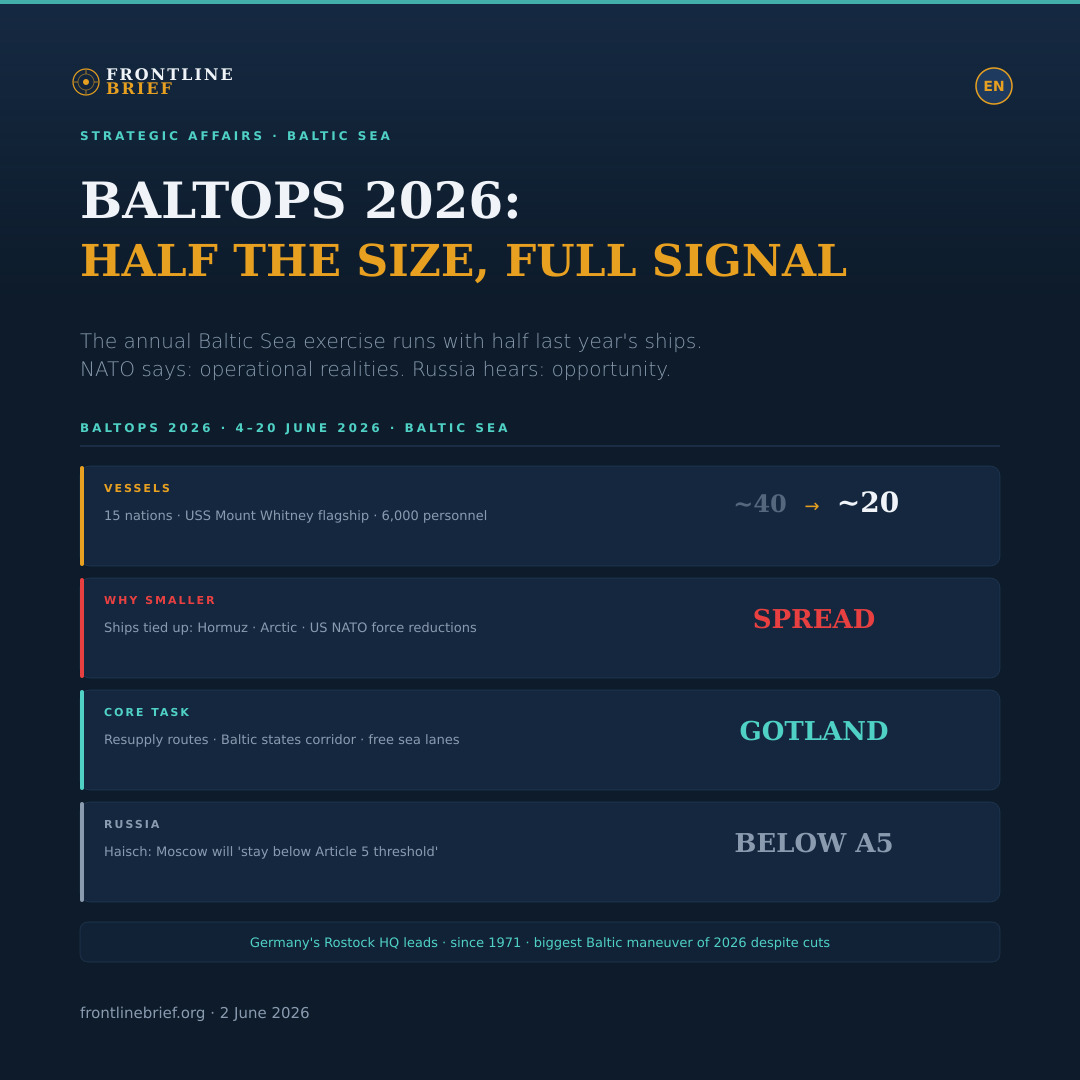
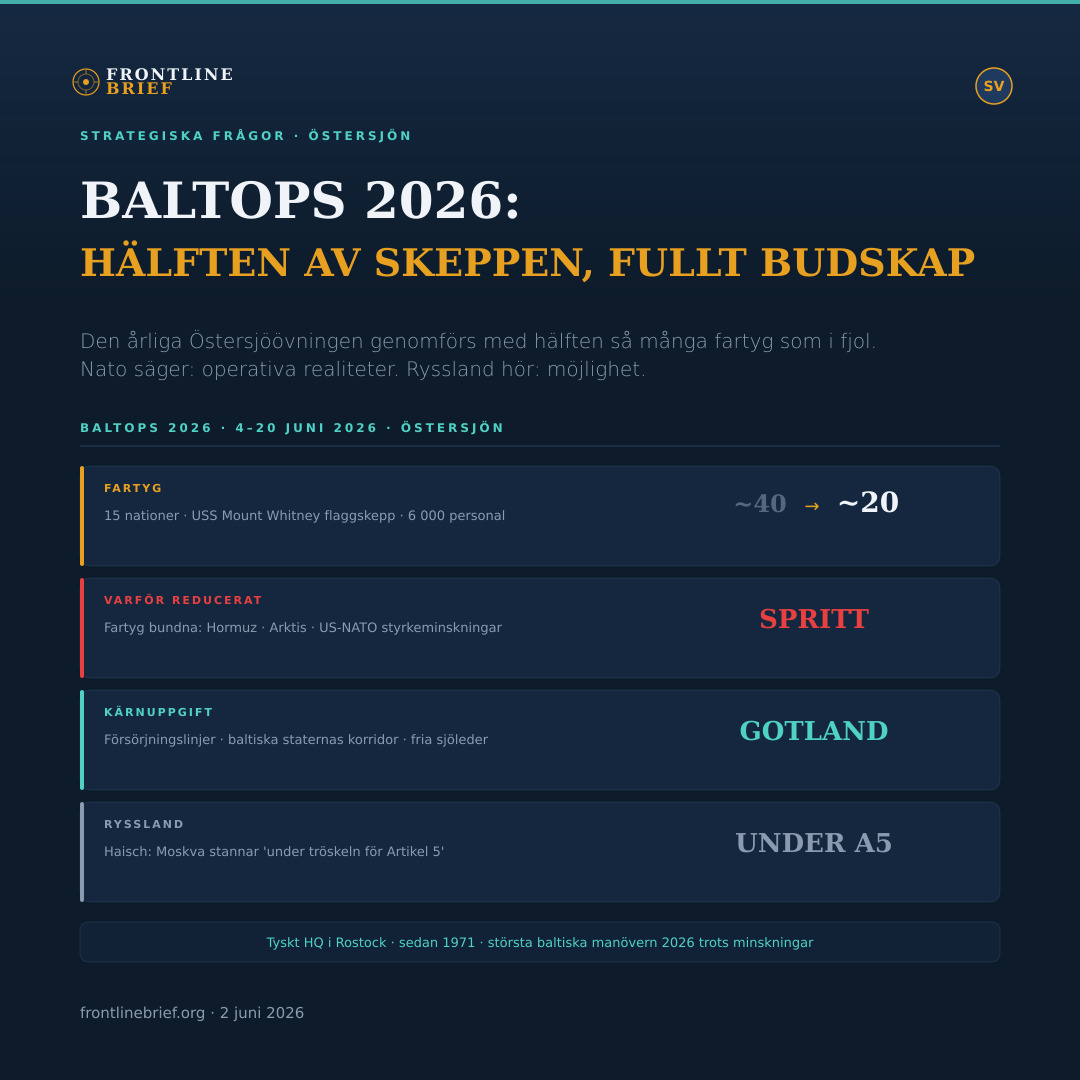
BALTOPS — the Baltic Operations exercise, running since 1971 — is the largest annual naval manoeuvre in the Baltic Sea. The 2026 edition, running from 4 to 20 June, brings together approximately 20 vessels from 15 nations, with around 6,000 personnel. That is roughly half the size of the 2025 edition. The USS Mount Whitney, the US Navy's command and control vessel, will serve as flagship — a visible signal that Washington remains the lead nation even as it reduces its overall NATO force commitments.
German Rear Admiral Stephan Haisch, who commands the multinational naval headquarters Germany established in Rostock in 2024, is blunt about the reason: Western navies are stretched. Ships that would ordinarily participate in BALTOPS are committed to other theatres — the Strait of Hormuz, where the Iran conflict has constrained commercial and military shipping alike; the Arctic, where Russia's posture has prompted increased allied patrol activity; and the general reallocation of US naval assets that follows from the broader NATO 3.0 force reduction framework announced in early June. "The smaller footprint reflects operational realities rather than waning commitment," Haisch said at a press briefing in Rostock.
In this period, it is a sign of the alliance's strength that a major exercise is being conducted, under US leadership, with broad NATO participation — Rear Admiral Stephan Haisch, Commander Task Force Baltic
What BALTOPS is actually rehearsing
The exercise begins in the western Baltic before shifting eastward to the waters around the Swedish island of Gotland — a shift that reflects the current strategic priority. Gotland sits at the centre of the Baltic Sea and dominates the sea lanes between the north and south Baltic. Control of or access to Gotland is considered critical for any NATO reinforcement or resupply operation into the Baltic states. Sweden's accession to NATO in 2024 has made Gotland's integration into allied planning significantly more straightforward, but rehearsing the actual logistics of supplying Estonia, Latvia and Lithuania — linked to the NATO mainland only by the narrow Suwalki corridor between Poland and Lithuania — remains the exercise's most operationally significant task.
Free sea lines of communication in the Baltic have taken on heightened importance since 2024, when a series of incidents — the cutting of data cables and gas pipelines attributed by Western officials to Russian-linked actors — demonstrated that infrastructure below the waterline is as vulnerable as anything above it. BALTOPS 2026 will include subsurface and mine-countermeasures elements specifically designed to rehearse the protection of this infrastructure.
The Russia question
Haisch was asked directly whether Russia might attempt to interfere with or respond to the exercise. His answer was carefully calibrated: "I would assume Russia to stay below the Article 5 threshold if they seek to test us." That phrasing — "if they seek to test us" — acknowledges the ambiguity that has characterised Russian behaviour in the Baltic since 2022. Russia has not directly attacked NATO assets, but it has conducted a persistent campaign of sub-threshold provocations: GPS spoofing, airspace violations by unmanned systems, and the infrastructure attacks attributed to it. Whether Russia chooses to use BALTOPS 2026 as an occasion for further testing depends in part on its assessment of NATO's credibility — an assessment that the reduced scale of this year's exercise may influence.
Η άσκηση και γιατί είναι μικρότερη
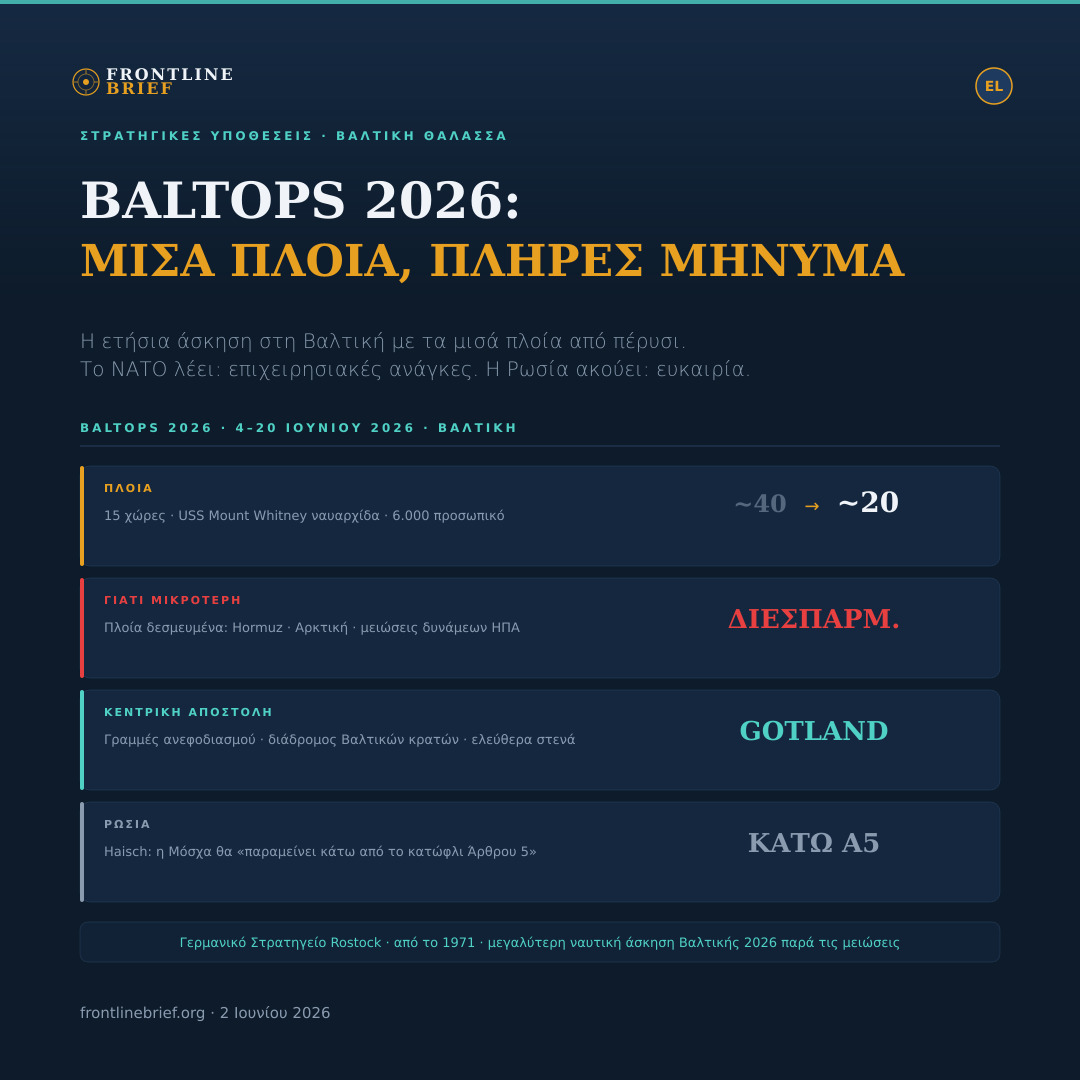
Το BALTOPS — η ετήσια ναυτική άσκηση στη Βαλτική από το 1971 — φέτος φέρνει περίπου 20 πλοία από 15 χώρες, με γύρω στους 6.000 ανθρώπους. Αυτό είναι περίπου το μισό σε σχέση με το 2025. Η USS Mount Whitney θα χρησιμεύσει ως ναυαρχίδα — ορατό σήμα ότι η Ουάσιγκτον παραμένει το κυρίαρχο κράτος παρά τις μειώσεις των δυνάμεών της στο ΝΑΤΟ.
Ο Γερμανός Αντιναύαρχος Stephan Haisch, επικεφαλής του πολυεθνικού ναυτικού στρατηγείου στο Rostock, είναι ευθύς για τον λόγο: τα δυτικά ναυτικά είναι κατανεμημένα σε πολλαπλά θέατρα. Πλοία που θα συμμετείχαν κανονικά στο BALTOPS δεσμεύονται αλλού — Στενό του Hormuz, Αρκτική, και οι γενικές ανακατανομές που απορρέουν από το πλαίσιο NATO 3.0. "Το μικρότερο αποτύπωμα αντικατοπτρίζει επιχειρησιακές πραγματικότητες και όχι εξασθένηση δέσμευσης", δήλωσε ο Haisch.
Σε αυτή την περίοδο, αποτελεί σημείο ισχύος της συμμαχίας ότι διεξάγεται μεγάλη άσκηση υπό αμερικανική ηγεσία — Αντιναύαρχος Stephan Haisch
Τι εκπαιδεύεται πραγματικά το BALTOPS
Η άσκηση ξεκινά στη δυτική Βαλτική πριν μετατοπιστεί ανατολικά προς τα ύδατα γύρω από το σουηδικό νησί Gotland — μετατόπιση που αντικατοπτρίζει την τρέχουσα στρατηγική προτεραιότητα. Το Gotland βρίσκεται στο κέντρο της Βαλτικής και κυριαρχεί τις θαλάσσιες γραμμές επικοινωνίας. Η εκτέλεση της πραγματικής εφοδιαστικής υποστήριξης Εσθονίας, Λεττονίας και Λιθουανίας — που συνδέονται με την ηπειρωτική χώρα του ΝΑΤΟ μόνο από τον στενό διάδρομο Suwalki — παραμένει η πιο επιχειρησιακά σημαντική αποστολή.
Το ερώτημα για τη Ρωσία
Ο Haisch ρωτήθηκε άμεσα αν η Ρωσία μπορεί να επιχειρήσει να παρέμβει. Η απάντησή του ήταν προσεκτικά διατυπωμένη: «Θα υπέθετα ότι η Ρωσία θα παραμείνει κάτω από το κατώφλι του Άρθρου 5 αν επιδιώξει να μας δοκιμάσει.» Η διατύπωση αυτή — «αν επιδιώξει να μας δοκιμάσει» — αναγνωρίζει την αμφισημία που χαρακτηρίζει τη ρωσική συμπεριφορά στη Βαλτική από το 2022. Η Ρωσία δεν έχει επιτεθεί άμεσα σε στρατιωτικά περιουσιακά στοιχεία του ΝΑΤΟ, αλλά διεξήγαγε επίμονη εκστρατεία υποκατωφλίων προκλήσεων: πλαστογράφηση GPS, παραβιάσεις εναέριου χώρου, επιθέσεις σε υποδομές.
L'exercice et pourquoi il est réduit
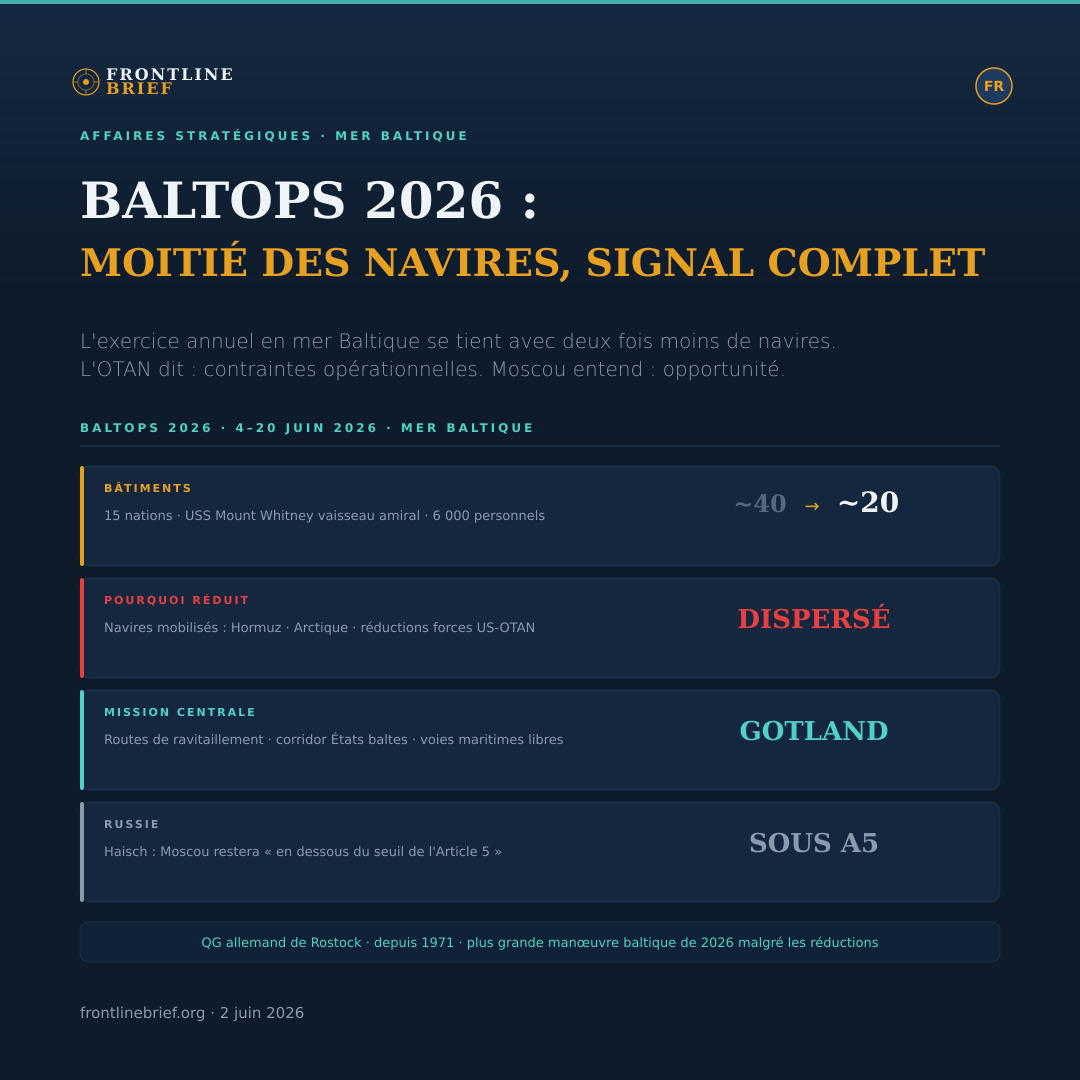
BALTOPS — le Baltic Operations exercise, organisé depuis 1971 — rassemble cette année environ 20 bâtiments de 15 nations, avec quelque 6 000 personnes. C'est environ la moitié de la taille de l'édition 2025. L'USS Mount Whitney servira de navire amiral — signal visible que Washington reste la nation de tête même en réduisant ses engagements globaux envers l'OTAN.
Le contre-amiral allemand Stephan Haisch est direct sur la raison : les marines occidentales sont dispersées sur plusieurs théâtres. Les navires qui auraient normalement participé à BALTOPS sont engagés ailleurs — détroit d'Ormuz, Arctique et réallocations générales découlant du cadre NATO 3.0. "Le format réduit reflète des réalités opérationnelles plutôt qu'un engagement déclinant", a-t-il déclaré.
En cette période, c'est un signe de la force de l'alliance qu'un exercice majeur soit conduit sous leadership américain — Contre-amiral Stephan Haisch
La question russe
Haisch a été interrogé directement sur une éventuelle interférence russe. Sa réponse était soigneusement formulée : "Je suppose que la Russie restera en dessous du seuil de l'Article 5 si elle cherche à nous tester." Cette formulation reconnaît l'ambiguïté qui caractérise le comportement russe en Baltique depuis 2022 : brouillage GPS, violations de l'espace aérien, attaques contre des infrastructures.
Øvelsen og hvorfor den er mindre
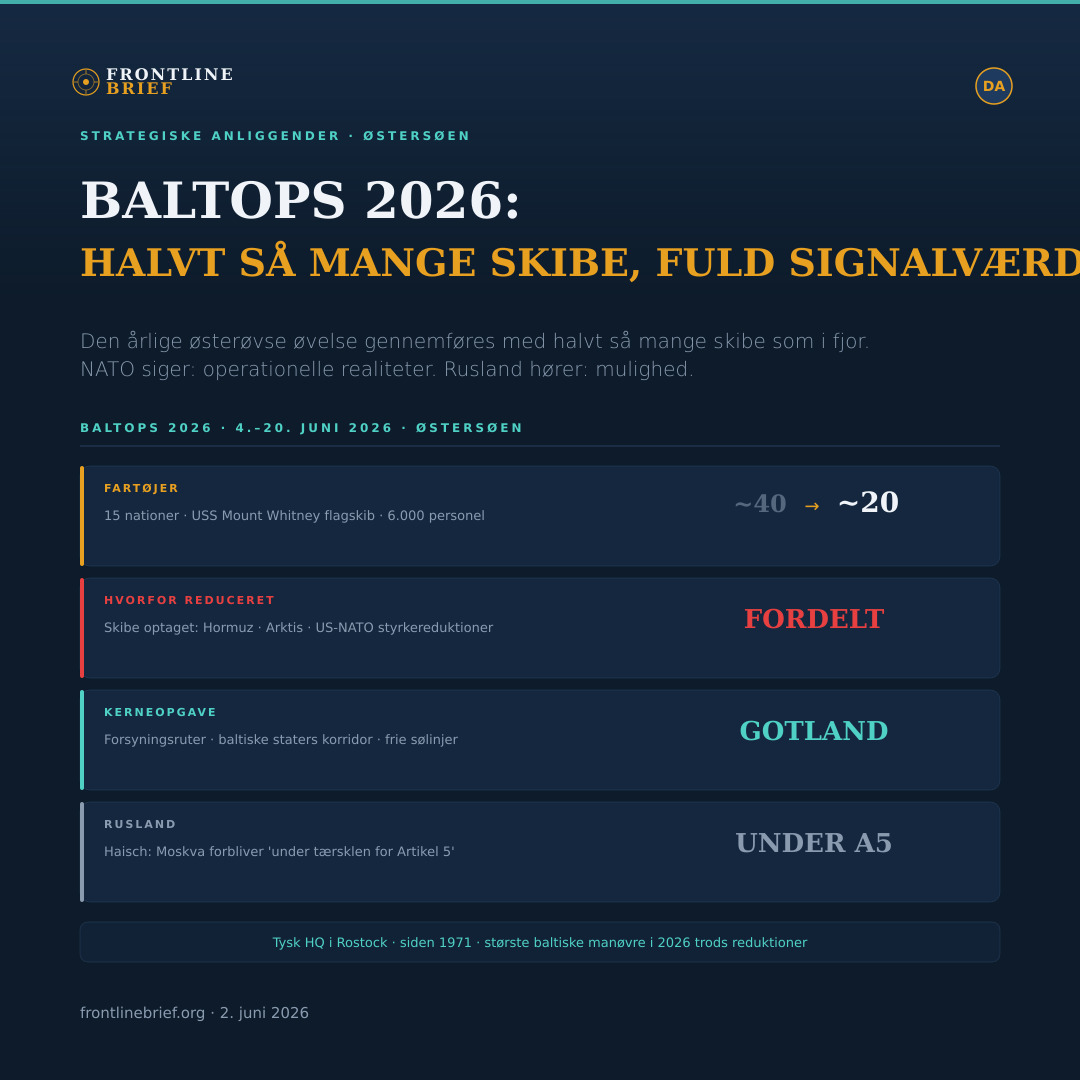
BALTOPS — Baltic Operations-øvelsen, som har fundet sted siden 1971 — samler i år ca. 20 fartøjer fra 15 nationer med ca. 6.000 personel. Det er omtrent halvdelen af 2025-udgavens størrelse. USS Mount Whitney fungerer som flagskib — et synligt signal om, at Washington fortsat er ledende nation, selv om det reducerer sine samlede NATO-forpligtelser.
Tysk kontreadmiral Stephan Haisch er direkte om årsagen: vestlige flåder er spredt over flere indsatsområder. Skibe, der normalt ville deltage i BALTOPS, er bundet til andre teatre — Hormuz-strædet, Arktis og de generelle omfordelinger der følger af NATO 3.0-rammen. "Det reducerede omfang afspejler operationelle realiteter snarere end svindende engagement," sagde han.
I denne periode er det et tegn på alliancens styrke, at en stor øvelse gennemføres under amerikansk ledelse — Kontreadmiral Stephan Haisch
Det russiske spørgsmål
Haisch blev spurgt direkte, om Rusland kunne forsøge at forstyrre øvelsen. Hans svar var omhyggeligt formuleret: "Jeg ville antage, at Rusland vil forblive under tærsklen for Artikel 5, hvis de søger at teste os." Den formulering anerkender den tvetydighed, der har præget russisk adfærd i Østersøen siden 2022: GPS-spoofing, luftrumsovertrædelser, infrastrukturangreb.
Övningen och varför den är mindre
BALTOPS — Baltic Operations-övningen, som pågått sedan 1971 — samlar i år ca 20 fartyg från 15 nationer med ca 6 000 personal. Det är ungefär hälften av 2025 års utgåvas storlek. USS Mount Whitney fungerar som flaggskepp — en synlig signal om att Washington förblir ledande nation, även om det minskar sina övergripande Nato-åtaganden.
Tysk konteramiral Stephan Haisch är rakt på sak om orsaken: västerländska flottor är spridda över flera teatrar. Fartyg som normalt skulle delta i BALTOPS är bundna till andra teatrar — Hormuzsundet, Arktis och de allmänna omfördelningar som följer av NATO 3.0-ramen. "Det reducerade fotavtrycket speglar operativa realiteter snarare än avtagande engagemang," sade han.
Under denna period är det ett tecken på alliansens styrka att en stor övning genomförs under amerikanskt ledarskap — Konteramiral Stephan Haisch
Rysslandsfrågan
Haisch tillfrågades direkt om Ryssland kunde försöka störa övningen. Hans svar var noggrant formulerat: "Jag skulle anta att Ryssland stannar under tröskeln för Artikel 5 om de söker testa oss." Den formuleringen erkänner den tvetydighet som karaktäriserat ryskt beteende i Östersjön sedan 2022: GPS-spoofing, luftrumsöverträdelser, infrastrukturattacker.