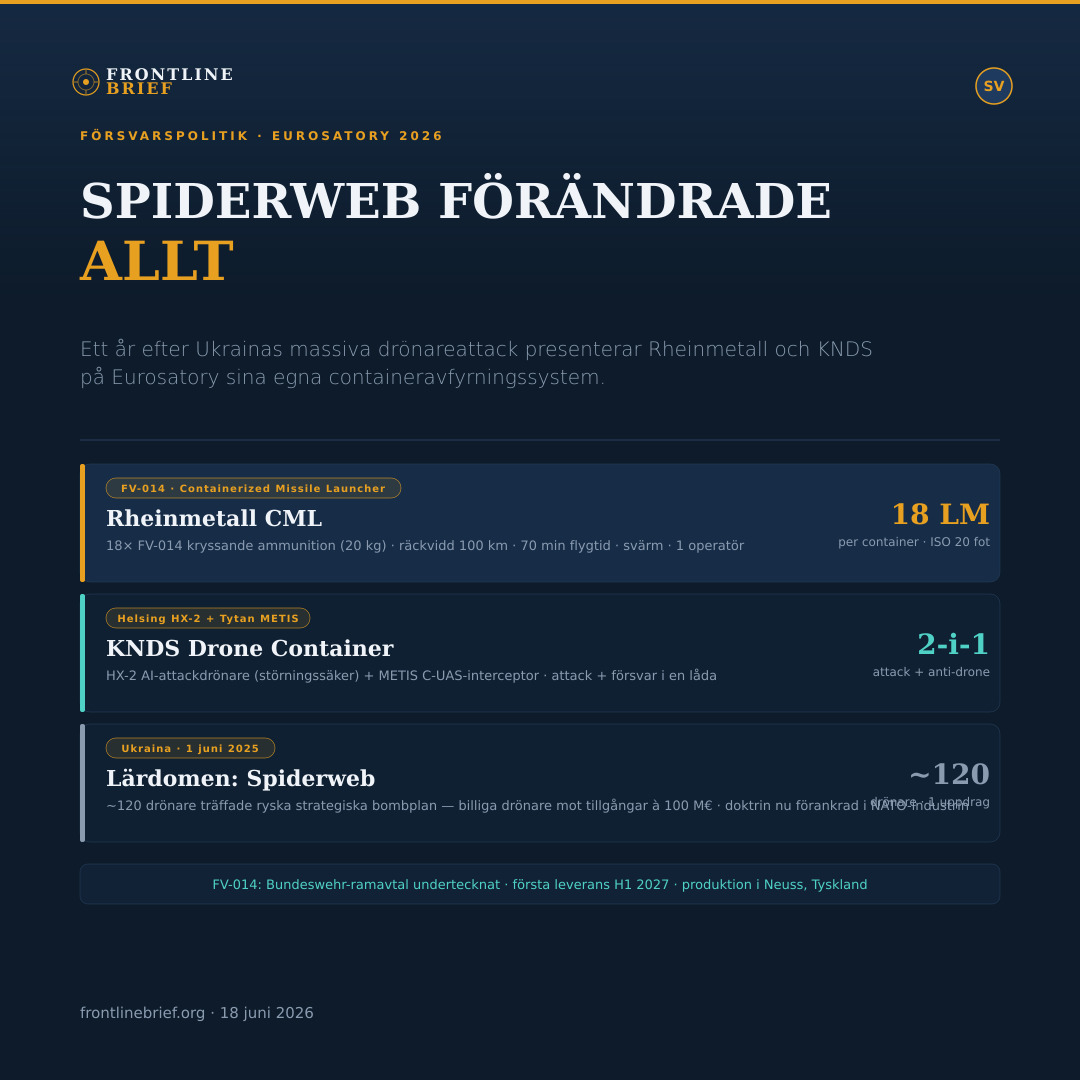
Why Operation Spiderweb matters to European industry
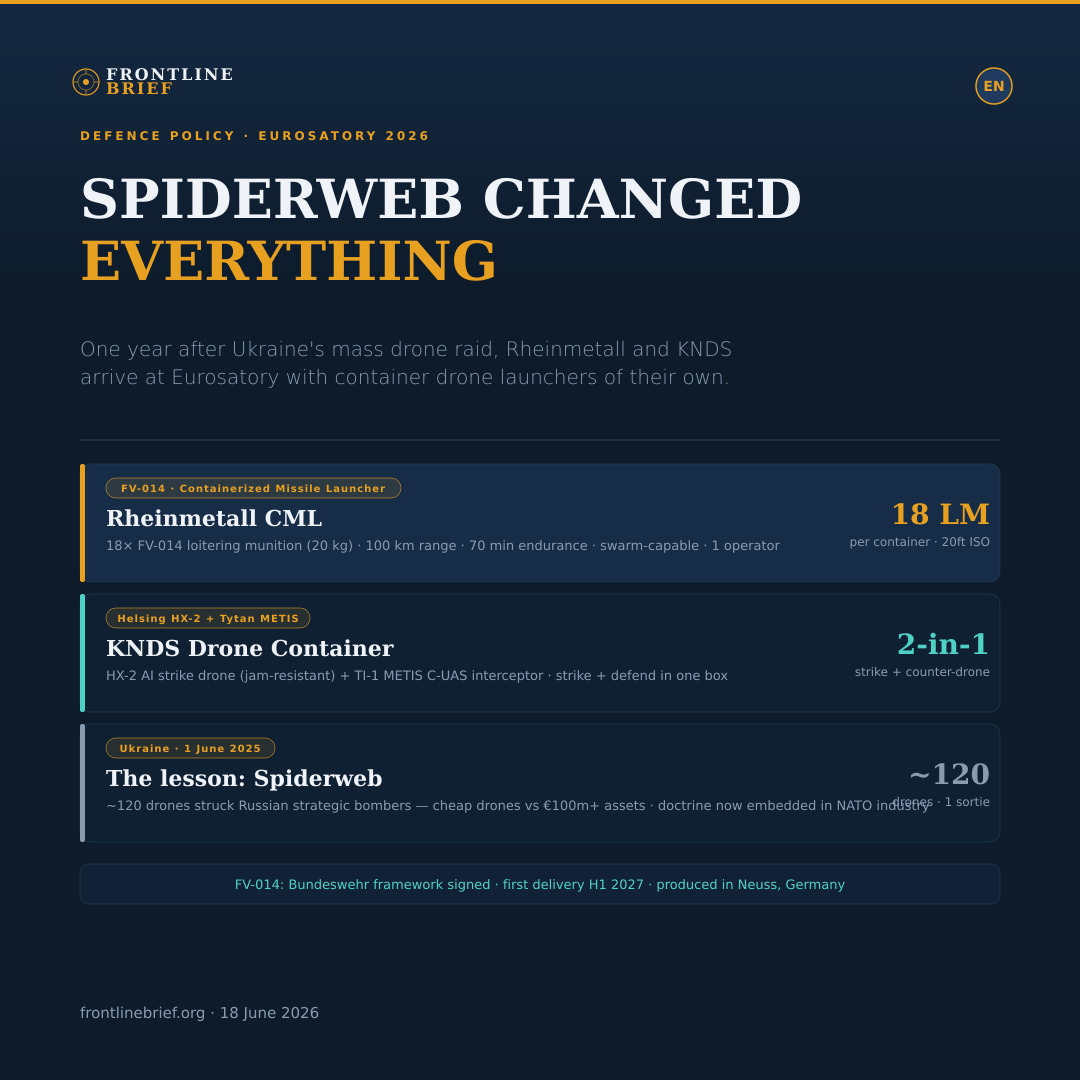
On 1 June 2025, Ukraine launched what became known as Operation Spiderweb: a coordinated drone strike against Russian long-range aviation at three airbases — Olenya in Murmansk Oblast, Engels in Saratov Oblast, and Dyagilevo in Ryazan Oblast. Approximately 120 low-cost, commercially derived fixed-wing drones were launched from multiple dispersed locations inside Russia by Ukrainian special operations teams. The drones successfully struck or damaged a number of Tu-95MS and Tu-160 strategic bombers — aircraft worth hundreds of millions of dollars each — using munitions costing a fraction of a percent of the targets they damaged. The operation demonstrated four principles that have become foundational to NATO drone doctrine: volume is a force multiplier; distributed launch complicates enemy targeting; separation of operator from launcher reduces risk to human operators; and GPS-denied autonomous navigation can function at scale.
One year later, Eurosatory 2026 is the moment when European industry confirms that those lessons have been absorbed and industrialised. At least two major systems on the exhibition floor — Rheinmetall's Containerized Missile Launcher and KNDS's Universal Drone Launch Container — apply Spiderweb's principles directly to a commercialised, mass-producible format: the standard 20-foot ISO shipping container.
A cheap drone can threaten a platform worth hundreds of millions. That is not a novelty — it is now a product line.
Rheinmetall's CML: 18 drones in a box
The Containerized Missile Launcher (CML) made its world premiere at Rheinmetall's booth at Eurosatory on 15 June. It is built around the FV-014, Rheinmetall's loitering munition system: a 20-kilogram drone with a quiet electric motor, a 360-degree swivelling gimbal camera, a 100-kilometre strike range and up to 70 minutes of loitering time. A single standard 20-foot ISO container holds 18 FV-014 units in ready-to-launch configuration. The entire system is operated by a single operator through Rheinmetall's Battlesuite software platform, which also integrates the FV-014 with the LUNA NG reconnaissance drone for combined intelligence-strike packages. The software architecture includes autonomous swarm coordination: one operator can control multiple drones simultaneously, launching salvos that overwhelm point air defences.
The commercial significance is not trivial. The German Armed Forces (Bundeswehr) have already signed a framework agreement worth billions of euros for the FV-014, with an initial delivery order valued at approximately 300 million euros. Production has begun at Rheinmetall's specialist facility in Neuss, with first major deliveries scheduled for the first half of 2027. The FV-014 and its CML launcher are explicitly designed for industrial mass production — a design philosophy that reflects Spiderweb's most fundamental lesson: the value of a loitering munition is only realised when it is available in quantity.
KNDS's container: strike and defend from the same box
KNDS's approach is architecturally different. Rather than filling a container with a single munition type, KNDS's prototype integrates two fundamentally different drone families into one 20-foot container: Helsing's HX-2 AI-defined loitering strike drone and Tytan's METIS and EOS interceptor family. The HX-2 is a software-defined drone engineered to resist jamming and continue executing mission functions after signal disruption — directly addressing one of the key vulnerabilities exposed in Spiderweb, where Russian electronic warfare attempted to blind incoming drones. The Tytan TI-1 METIS is a cost-efficient kinetic interceptor designed to engage incoming enemy drones — meaning the container can simultaneously launch its own strike drones while defending itself and nearby assets against the enemy's drone response. The TI-2 EOS interceptor extends that defensive bubble to 60 kilometres range at up to 5,000 metres altitude.
KNDS describes this as a "combined strike and local air defence node" — a single container that can both threaten and protect, without requiring dedicated counter-drone vehicles alongside it. The container includes its own power supply, environmental controls and network connectivity, allowing it to remain loaded and operational for extended periods. The design reflects KNDS's broader "Mission Solution" concept presented at Eurosatory, which links manned platforms, drones, loitering munitions, C-UAS systems and command posts into a single operational architecture.
The doctrine behind the hardware
Both systems embody a doctrine that has emerged directly from the war in Ukraine: mass, distribution and autonomy are the three variables that determine whether drone attacks succeed or fail at scale. Mass means launching enough units that even a capable air-defence system is saturated. Distribution means launching from enough separate locations that targeting the launchers requires as many resources as targeting the drones themselves. Autonomy means the drones can complete their mission even if communications are degraded or jammed. Operation Spiderweb was the proof of concept. The CML and KNDS container are the product lines.
Γιατί η επιχείρηση Spiderweb έχει σημασία για την ευρωπαϊκή βιομηχανία
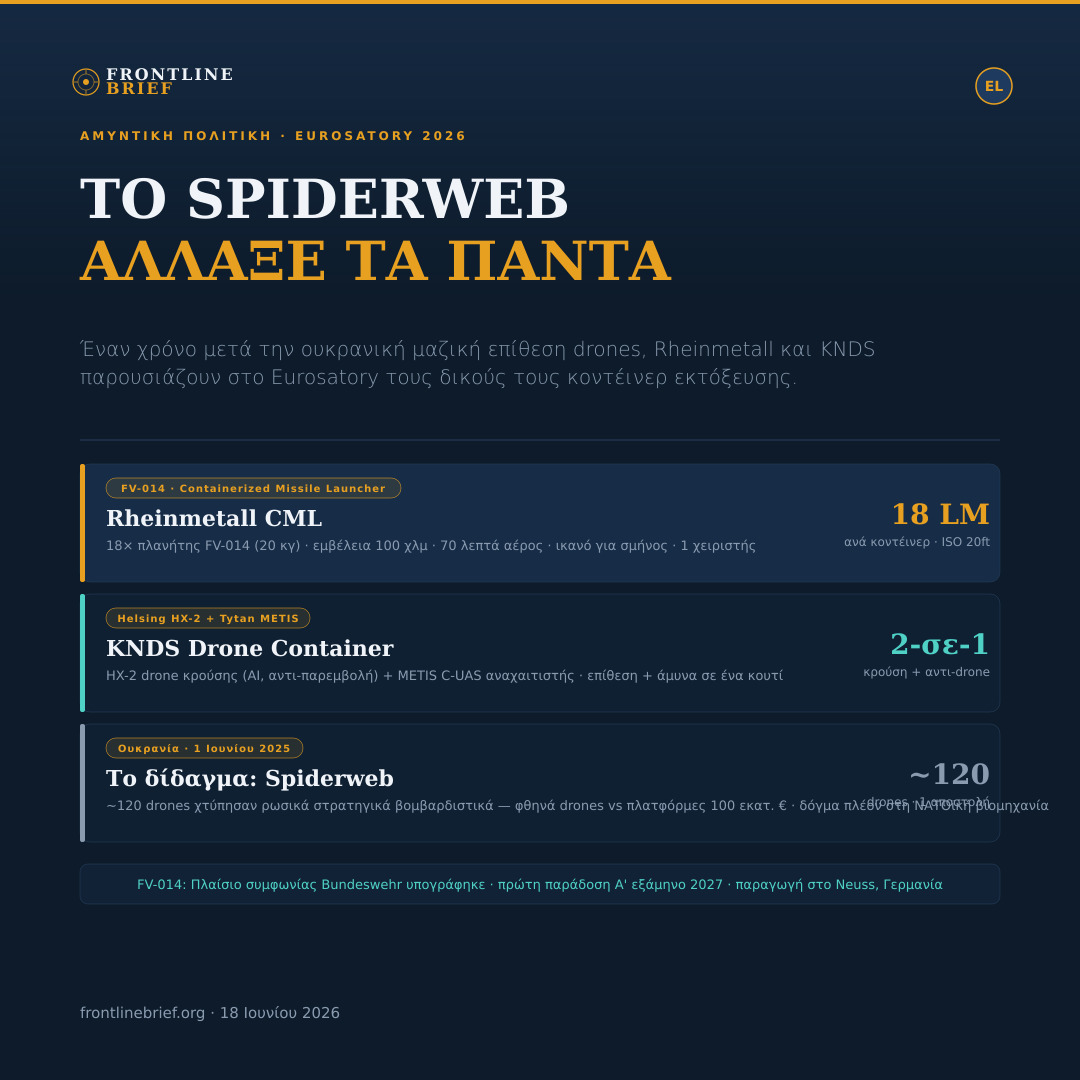
Την 1η Ιουνίου 2025, η Ουκρανία εξαπέλυσε αυτό που έγινε γνωστό ως επιχείρηση Spiderweb: μια συντονισμένη επίθεση drones εναντίον της ρωσικής μακράς εμβέλειας αεροπορίας σε τρεις αεροβάσεις — Olenya στην Περιφέρεια Μούρμανσκ, Engels στη Σαράτοφ και Dyagilevo στο Ριαζάν. Περίπου 120 οικονομικά drones εκτοξεύτηκαν από πολλαπλές διάσπαρτες θέσεις μέσα στη Ρωσία από ουκρανικές δυνάμεις ειδικών επιχειρήσεων. Τα drones έπληξαν ή έβλαψαν αριθμό βομβαρδιστικών Tu-95MS και Tu-160 — αεροσκάφη αξίας εκατοντάδων εκατομμυρίων δολαρίων — χρησιμοποιώντας βλήματα που κόστιζαν ένα κλάσμα της αξίας των στόχων τους.
Ένα χρόνο αργότερα, το Eurosatory 2026 είναι η στιγμή που η ευρωπαϊκή βιομηχανία επιβεβαιώνει ότι αυτά τα διδάγματα έχουν απορροφηθεί και βιομηχανοποιηθεί. Τουλάχιστον δύο μεγάλα συστήματα στο χώρο έκθεσης — το Containerized Missile Launcher της Rheinmetall και το Universal Drone Launch Container της KNDS — εφαρμόζουν τις αρχές του Spiderweb σε εμπορικό, μαζικά παραγόμενο format: το τυποποιημένο κοντέινερ ISO 20 ποδών.
Ένα φθηνό drone μπορεί να απειλήσει μια πλατφόρμα αξίας εκατοντάδων εκατομμυρίων. Αυτό δεν είναι πλέον νεωτερισμός — είναι πλέον γραμμή προϊόντος.
Rheinmetall CML: 18 drones σε ένα κουτί
Το Containerized Missile Launcher (CML) έκανε την παγκόσμια πρεμιέρα του στις 15 Ιουνίου. Βασίζεται στο FV-014: ένα drone 20 κιλών με ηλεκτρικό κινητήρα, κάμερα gimbal 360°, εμβέλεια 100 χλμ. και χρόνο παραμονής 70 λεπτά. Ένα κοντέινερ ISO 20 ποδών χωράει 18 μονάδες FV-014 σε διαμόρφωση έτοιμης εκτόξευσης. Ο ελέγχεται από έναν μόνο χειριστή μέσω της πλατφόρμας λογισμικού Battlesuite. Η Bundeswehr έχει ήδη υπογράψει συμφωνία-πλαίσιο δισεκατομμυρίων ευρώ για το FV-014, με αρχική παραγγελία 300 εκατ. €. Πρώτες παραδόσεις: Α' εξάμηνο 2027.
KNDS: κρούση και άμυνα από το ίδιο κουτί
Η KNDS ενσωματώνει δύο διαφορετικά είδη drones σε ένα κοντέινερ: τα drone κρούσης HX-2 της Helsing (AI, αντιπαρεμβολή) και τους αναχαιτιστές METIS/EOS της Tytan. Το αποτέλεσμα: ένα κοντέινερ που μπορεί ταυτόχρονα να εκτοξεύει τα δικά του drones και να αμύνεται έναντι των εισερχόμενων εχθρικών drones. Το TI-2 EOS εκτείνει αυτή την αμυντική φούσκα σε εμβέλεια 60 χλμ. σε ύψος 5.000 μέτρων.
Pourquoi l'opération Spiderweb importe à l'industrie européenne
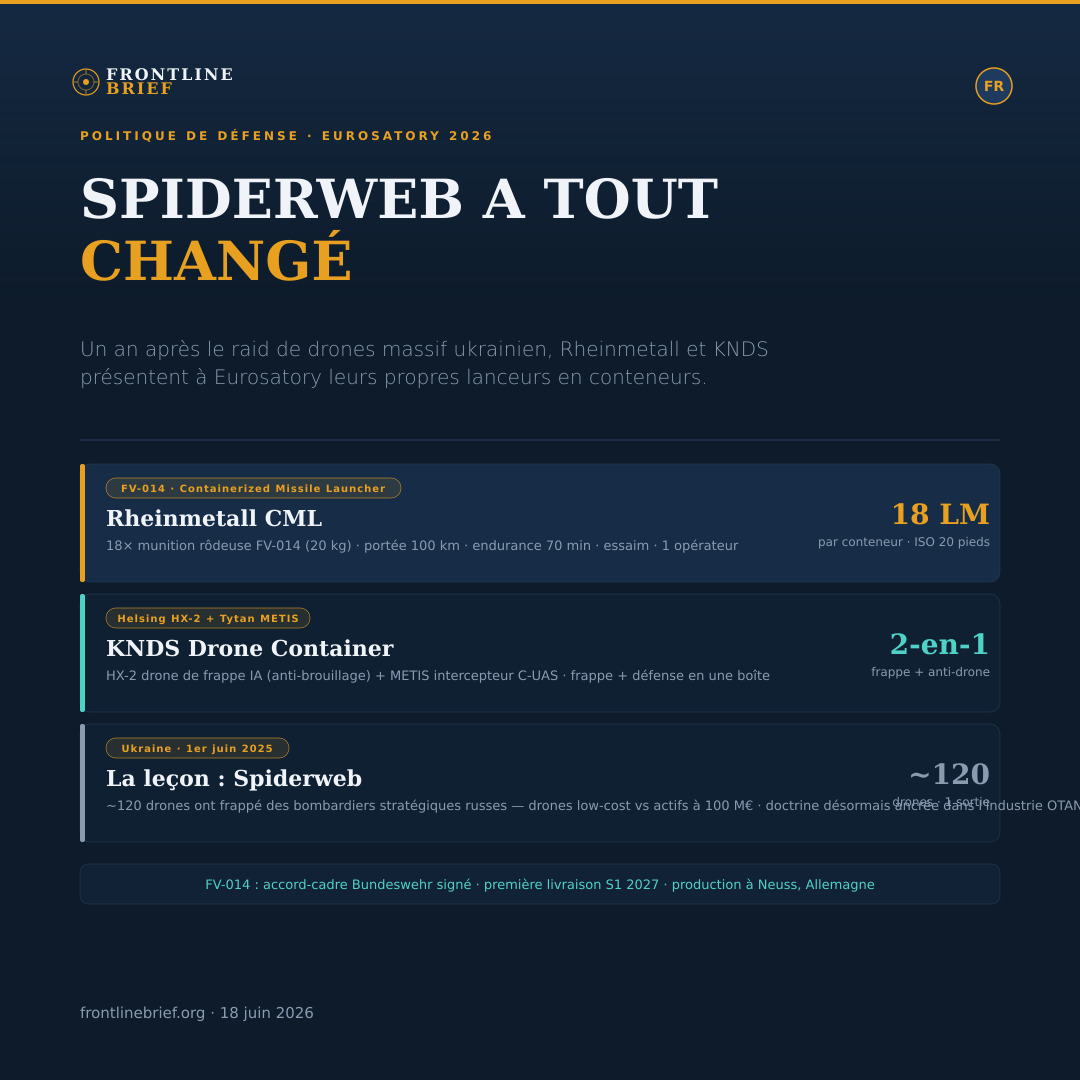
Le 1er juin 2025, l'Ukraine a lancé l'opération Spiderweb : une frappe coordonnée de drones contre l'aviation russe à longue portée sur trois bases aériennes. Environ 120 drones à bas coût ont été lancés depuis de multiples sites dispersés en Russie par des forces spéciales ukrainiennes. Les drones ont frappé ou endommagé des bombardiers Tu-95MS et Tu-160 — des aéronefs valant des centaines de millions de dollars chacun — en utilisant des munitions coûtant une infime fraction de la valeur des cibles.
Un an plus tard, Eurosatory 2026 marque le moment où l'industrie européenne confirme que ces leçons ont été absorbées et industrialisées. Au moins deux systèmes majeurs — le Containerized Missile Launcher de Rheinmetall et le conteneur universel de drones de KNDS — appliquent directement les principes de Spiderweb à un format commercialisé et à grande échelle de production : le conteneur ISO de 20 pieds standard.
Un drone bon marché peut menacer une plateforme valant des centaines de millions. Ce n'est plus une nouveauté — c'est désormais une ligne de produits.
Le CML de Rheinmetall : 18 drones dans une boîte
Le Containerized Missile Launcher (CML) a fait sa première mondiale le 15 juin. Il repose sur le FV-014 : un drone de 20 kg, moteur électrique silencieux, caméra stabilisée 360°, portée 100 km, 70 minutes d'endurance. Un conteneur ISO standard de 20 pieds contient 18 unités FV-014 en configuration prête à lancer. La Bundeswehr a déjà signé un accord-cadre de plusieurs milliards d'euros, avec une commande initiale d'environ 300 millions d'euros. Premières livraisons : premier semestre 2027, production à Neuss, Allemagne.
KNDS : frappe et défense depuis la même boîte
KNDS intègre deux familles de drones dans un conteneur : les drones de frappe HX-2 d'Helsing (IA, résistants au brouillage) et les intercepteurs METIS/EOS de Tytan. Résultat : un conteneur qui peut simultanément lancer ses propres drones et se défendre contre les drones ennemis entrants. Le TI-2 EOS étend cette bulle défensive à 60 km de portée à 5 000 m d'altitude.
Hvorfor Operation Spiderweb betyder noget for europæisk industri
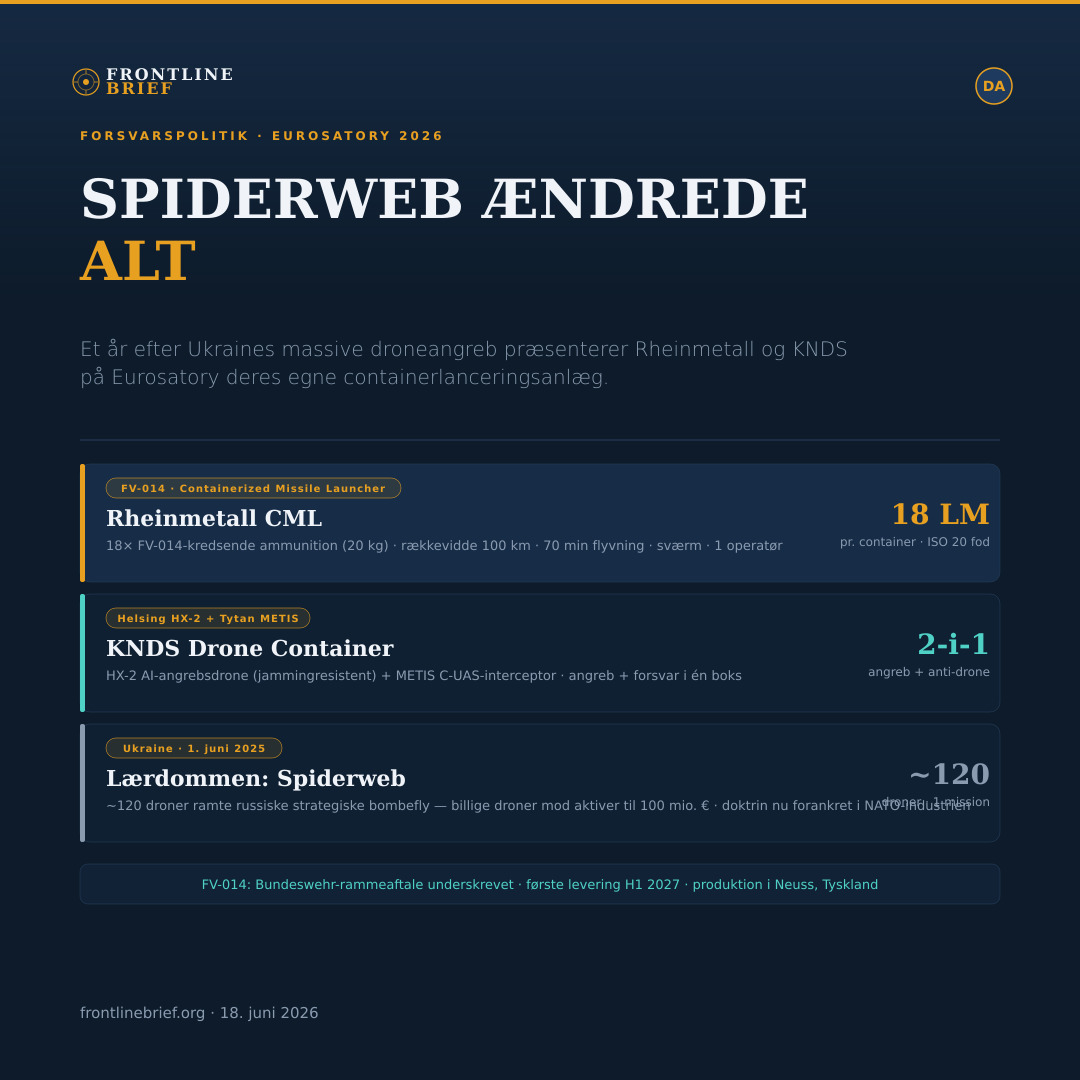
Den 1. juni 2025 gennemførte Ukraine Operation Spiderweb: et koordineret droneangreb mod russisk langdistanceluftfart på tre luftbaser. Ca. 120 lavpris-droner blev affyret fra adskillige spredte steder i Rusland af ukrainske specialstyrker. Dronerne ramte Tu-95MS og Tu-160 strategiske bombefly — fly til hundredvis af millioner dollars — med ammunition der kostede en brøkdel af deres mål.
Et år senere bekræfter Eurosatory 2026, at disse lærdommer er absorberet og industrialiseret. Rheinmetall CML og KNDS Universal Drone Launch Container anvender Spiderwebs principper på et kommercialiserbart format: den standard 20-fods ISO-container.
En billig drone kan true en platform til hundredvis af millioner. Det er ikke en nyhed — det er nu en produktlinje.
Rheinmetalls CML: 18 droner i en kasse
CML'en rummer 18× FV-014 (20 kg, 100 km rækkevidde, 70 min flyvning) i en standard 20-fods ISO-container. Én operatør styrer alle droner via Battlesuite-software. Bundeswehr har underskrevet en rammeaftale til milliarder af euro; første leveringer H1 2027, produktion i Neuss.
KNDS: angreb og forsvar fra samme kasse
KNDS integrerer Helsing HX-2 AI-angrebsdroner og Tytan METIS/EOS-interceptorer i én container — den kan affyre angrebsdroner og afskære fjendtlige droner på samme tid. TI-2 EOS når 60 km afstand op til 5.000 meters højde.
Varför Operation Spiderweb spelar roll för europeisk industri
Den 1 juni 2025 genomförde Ukraina Operation Spiderweb: en samordnad drönareattack mot ryskt långdistansflyg på tre flygbaser. Ungefär 120 lågprisdrönare avfyrades från flera spridda platser i Ryssland av ukrainska specialstyrkor. Drönarna träffade Tu-95MS och Tu-160 strategiska bombplan — flygplan värda hundratals miljoner dollar vardera — med ammunition som kostade en bråkdel av deras måls värde.
Ett år senare bekräftar Eurosatory 2026 att dessa lärdomar har absorberats och industrialiserats. Rheinmetalls CML och KNDS Universal Drone Launch Container tillämpar Spiderwebs principer på ett kommersialiserbart format: den standard 20-fots ISO-containern.
En billig drönare kan hota en plattform värd hundratals miljoner. Det är inte en nyhet — det är nu en produktlinje.
Rheinmetalls CML: 18 drönare i en låda
CML:en rymmer 18× FV-014 (20 kg, 100 km räckvidd, 70 min flygtid) i en standard 20-fots ISO-container. En operatör styr alla drönare via Battlesuite-programvara. Bundeswehr har undertecknat ett ramavtal värt miljarder euro; första leveranser H1 2027, produktion i Neuss.
KNDS: attack och försvar från samma låda
KNDS integrerar Helsing HX-2 AI-attackdrönare och Tytan METIS/EOS-interceptorer i en container — den kan avfyra attackdrönare och avskjuta fientliga drönare samtidigt. TI-2 EOS når 60 km räckvidd upp till 5 000 meters höjd.